
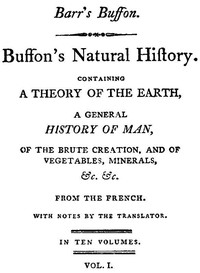
Buffon's Natural History, Volume 01 (of 10) by Buffon
Okay, let's be clear: this isn't a novel. There's no plot in the traditional sense. 'Buffon's Natural History, Volume 1' is the opening argument of a 44-volume life's work. Buffon doesn't just list animals. He starts by asking the biggest questions possible. How did the Earth form? How do species come to be? What are the fundamental laws of life? He lays out his theories on what we'd now call geology, cosmology, and biology, all woven together into a single, grand narrative of the natural world.
The Story
Think of it as the origin story for Buffon's entire project. He begins with the solar system, proposing a theory about planetary formation (involving a comet striking the sun!). Then he moves to Earth, discussing its cooling, the formation of mountains and seas, and the appearance of life. This volume sets the stage for all the detailed animal descriptions that follow in later books. The 'story' is the story of nature itself, as understood by an 18th-century French intellectual with an insatiable curiosity and the resources of the King's garden at his disposal.
Why You Should Read It
Reading Buffon is a unique experience. It's not about learning facts (many are wrong). It's about witnessing the process of scientific thinking in its early, majestic, and often flawed glory. You feel his excitement as he connects ideas. You also see the limits of his era—the lack of fossil evidence, the religious constraints, the gaps in basic knowledge. It's humbling and thrilling. It makes you appreciate how much we now know, and how hard-won that knowledge was. Buffon's writing, even in translation, has a confident, sweeping style. He's not just a collector; he's a philosopher of nature, trying to impose order on a chaotic world.
Final Verdict
This book is perfect for history and science lovers who enjoy seeing where our ideas came from. It's for the patient reader who doesn't mind a slower, more contemplative pace. If you loved 'The Age of Wonder' or are fascinated by figures like Darwin or Humboldt, you need to meet their influential predecessor. Start with Volume 1 to see the blueprint. It's a challenging but incredibly rewarding look into the mind of a man who helped invent the way we look at the living world. Just be ready to Google a lot—it's a conversation across 250 years, and sometimes you need a modern footnote.
There are no legal restrictions on this material. You can copy, modify, and distribute it freely.
Michael Davis
5 months agoWhile browsing through various academic sources, the bibliography and references suggest a high level of research and authority. This is a solid reference for both beginners and experts.
Jessica Williams
4 months agoAfter finishing this book, it manages to explain difficult concepts in plain English. I would gladly recommend this title.
Lucas Taylor
10 months agoWithout a doubt, the narrative structure is incredibly compelling. I learned so much from this.
Brian Wilson
9 months agoUsed this for my thesis, incredibly useful.


Susan Miller
2 months agoHaving followed this topic for years, I can say that the author doesn't just scratch the surface but goes into meaningful detail. Simple, effective, and authoritative – what else could you ask for?