
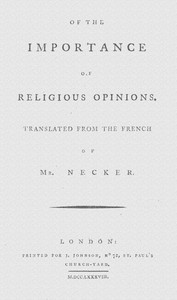
Of the importance of religious opinions by Jacques Necker
Let's set the scene: it's 1788. France is a powder keg of debt and social inequality. Jacques Necker, the popular but ultimately unsuccessful finance minister, publishes this essay. It's not a story with characters and a plot in the traditional sense. Think of it as a long, thoughtful letter to the public. The 'story' here is the argument Necker builds. He looks at the world around him—increasing skepticism, new philosophical ideas challenging old authorities—and gets worried. He believes that when a society abandons shared religious principles, it risks falling apart. Morality, he argues, needs a foundation stronger than just human laws or fleeting self-interest.
The Story
The book is Necker's case for why religion matters, even to skeptics. He walks through his logic: societies need common bonds. Shared beliefs about right and wrong, about something bigger than ourselves, create those bonds. He suggests that religious opinions act as a kind of internal police, guiding behavior in a way that external laws never can. The narrative follows his attempt to convince his readers that preserving these shared beliefs is crucial for public order, happiness, and social survival. It's the intellectual journey of a statesman trying to apply a spiritual salve to a very worldly crisis.
Why You Should Read It
Reading this is like finding a receipt in the pocket of an old coat. It tells you what someone was trying to buy at a specific moment in time. Necker's plea is deeply personal because you can feel his anxiety. He's not a fire-and-brimstone preacher; he's a pragmatic administrator making a practical argument for faith. The power comes from the dramatic irony. We know the French Revolution—with its dechristianization campaign and terror—is just around the corner. Reading his hopeful, reasoned argument for religious cohesion while knowing it failed is haunting. It forces you to ask his questions in a modern context: What holds our diverse societies together today? Is it laws, economics, or do we still rely on some shared set of values?
Final Verdict
This book is perfect for history lovers who enjoy primary sources, and for anyone interested in the never-ending debate about religion's place in public life. It's not a beach read; it requires some focus. But if you want to get inside the head of a key figure on the eve of a world-changing event, and grapple with ideas that are still fiercely relevant, this short essay is a brilliant and sobering time capsule. You're not just reading an argument; you're witnessing a last-ditch effort to save a world that was already lost.
This historical work is free of copyright protections. Feel free to use it for personal or commercial purposes.
Mary Rodriguez
1 month agoThought-provoking and well-organized content.
Jennifer Harris
10 months agoUnlike many other resources I've purchased before, the visual layout and supporting data make the reading experience very smooth. Finally, a source that prioritizes accuracy over hype.
Michael Davis
9 months agoI was particularly interested in the case studies mentioned here, the formatting on mobile devices is surprisingly crisp and clear. Definitely a five-star contribution to the field.
Barbara Garcia
2 years agoExactly what I was looking for, thanks!







Sarah Thomas
1 year agoThe clarity of the introduction set high expectations, and the language used is precise without being overly academic or confusing. Finally, a source that prioritizes accuracy over hype.