
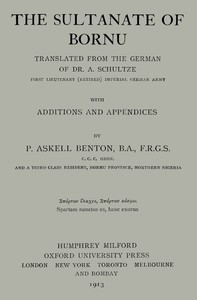
The Sultanate of Bornu by Arnold Schultze
Arnold Schultze's The Sultanate of Bornu is a unique window into a world most of us have never seen. Written in the early 20th century, it's part travelogue, part historical record, and part cultural snapshot of a major African empire at a pivotal moment.
The Story
This isn't a novel with a single plot, but the story it tells is gripping. Schultze traces the incredible thousand-year arc of the Bornu Empire, located around Lake Chad. He starts with its origins and takes us through its peak as a dominant political and economic force, controlling trans-Saharan trade routes and building a sophisticated society. The book details its military strength, its complex administration, and its rich cultural and religious life. The narrative's real tension comes from its final third, where Schultze documents the empire's gradual decline due to internal pressures and the encroaching influence of European colonial powers. He was writing while some of this was still unfolding, giving his account a rare, on-the-ground perspective.
Why You Should Read It
You should read this to fill a massive gap in your historical knowledge. Bornu was a contemporary of medieval European kingdoms and a giant in its own right, yet it's rarely mentioned. Schultze's writing, while of its time, is driven by a clear effort to understand and document. He describes landscapes, interviews local rulers and citizens, and records customs and stories that were fading even then. Reading it feels like being shown a precious, detailed map of a place that has since been radically redrawn. It challenges the single-story narrative of African history and reveals the depth and resilience of pre-colonial states. It’s a foundational text that makes you realize how much history is waiting to be discovered.
Final Verdict
This book is perfect for curious readers and history buffs who want to step off the well-trodden path. It's especially valuable for anyone interested in African history, the pre-colonial world, or the dynamics of empire. A heads-up: the writing style is early 1900s academic, so it's not a breezy beach read. But if you're willing to settle into its rhythm, you'll be rewarded with a profound look at a lost civilization from a witness who was there. Think of it as an essential primary source, packed with insight and a sense of immediacy you won't find in modern summaries.
Legal analysis indicates this work is in the public domain. Share knowledge freely with the world.
Paul Harris
3 weeks agoAs a professional in this niche, the wealth of information provided exceeds the average market standard. I'll be citing this in my upcoming project.
Matthew White
10 months agoI appreciate how this edition approaches the core problem, the language used is precise without being overly academic or confusing. It cleared up a lot of the confusion I had previously.
Sarah Gonzalez
1 year agoFrom a researcher's perspective, the author clearly has a deep mastery of the subject matter. I'll be citing this in my upcoming project.
Joseph White
7 months agoThe layout of the digital version made it easy to start immediately, the wealth of information provided exceeds the average market standard. I'm genuinely impressed by the quality of this digital edition.






Joseph Wilson
7 months agoThe clarity of the introduction set high expectations, and the narrative arc keeps the reader engaged while delivering factual content. I am looking forward to the author's next publication.