1

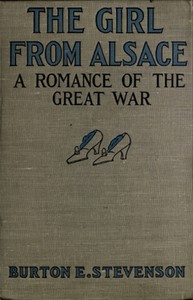
The Girl from Alsace A Romance of the Great War, Originally Published under the Title of Little Comrade — A Closer Reading
(0 User reviews)
1512
Project Gutenberg
2011
Not confirmed
World War, 1914-1918 -- Fiction; War stories; Alsace (France) -- Fiction
Readers of public-domain and historical texts
Project Gutenberg digital edition
en
Edition facts
Words
67,992
Reading time
296 min
Text sections
7
The catalog record for The Girl from Alsace A Romance of the Great War, Originally Published under the Title of Little Comrade — A Closer Reading provides practical reading context through 67,992 words, 4 hr 56 min estimated reading time, and 7 detected text sections.
The text analysis averages about 14.3 words per sentence, while the detected sections provide another way to judge how the source is divided.
Project Gutenberg metadata also associates the work with “World War, 1914-1918 -- Fiction,” connecting these edition facts with the source record’s subject description.
Source:
Project Gutenberg record #35926
Burton Egbert Stevenson's 1915 romance uses precise diction and sensory detail to evoke the onset of World War I in Alsace, contrasting pre-war camaraderie with the brutal realities of invasion through the perspectives of an American doctor and a French girl.
Read the complete public-domain text at its original source.
Read on Project GutenbergThe novel opens with a leisurely scene on a Cologne terrace, where two new friends—an American doctor and a German surgeon—share a farewell coffee. Stevenson establishes their bond through mutual language tutoring: the American's "German lame and halting" improved by Bloem, while Bloem's "Teutonic involutions" are smoothed by Stewart. This reciprocal arrangement hints at a broader theme of cross-cultural understanding soon to be shattered by war. The author's diction in these early pages—"medieval Nuremberg," "odorous Würzburg," "mountain-shadowed Heidelberg"—creates a romanticized Central Europe that will be violently redefined.
The Weight of a Half-Open Door
Stevenson builds suspense through small, deliberate details. When Stewart and his companion approach a deserted farmhouse, the narrator notes: "There was something vaguely sinister in the position of the door, half-open and half-closed." The phrase is repeated almost verbatim from the novel's epigraph—"THERE WAS SOMETHING SINISTER AND THREATENING ABOUT THOSE ROOFLESS BLACKENED WALLS"—linking the farmhouse to an earlier ruin. Inside, the disorder is catalogued with clinical precision: "Chairs were overturned, a table was lying on its side with one leg broken, dishes lay smashed upon the floor." The accumulation of concrete objects—a bread-knife, a huddled figure, a shattered forehead—forces the reader to infer violence without explicit narration. Stevenson trusts the evidence of things seen.
Dialogue as a Barometer of Shock
The characters' speech patterns shift markedly after encountering the murdered woman. Stewart's earlier confident banter gives way to stammered disbelief: "but I don't understand. Germany is a civilized nation—war is no longer the brutal thing it once was." The girl's reply is measured, almost weary: "War is always brutal, I fear; and of course, among a million men, there are certain to be some—like that!" Her use of "I fear" rather than a stronger verb, and the dismissive "like that," suggests a familiarity with horror that Stewart lacks. This asymmetry in their responses—his theoretical outrage, her practical resignation—underscores a key authorial choice: the war is filtered through two contrasting sensibilities, neither fully prepared for what they witness.
The Rhythm of Retreat and Observation
Stevenson structures the flight westward as a series of sensory impressions rather than a continuous narrative. Stewart's mind "was full of other things—of the gray-clad thousands singing as they marched; of the radiant face of the Crown Prince; of that poor murdered woman." The juxtaposition of singing soldiers and a bludgeoned corpse is deliberately jarring. The author avoids lengthy battle descriptions; instead, the war is registered through its aftermath: abandoned farms, broken furniture, a single body. Even the landscape is read for signs: "The Uhlans have passed this way," the girl says, interpreting the empty yard as a text. This method—showing war through its traces—gives the prose a documentary quality while maintaining emotional immediacy.
The Unspoken Contract of the Title
The publisher's note reveals that the novel was originally titled Little Comrade, changed to The Girl from Alsace as "better descriptive of the character of the story." The shift from a relational term ("comrade") to a geographic one ("from Alsace") signals a change in emphasis: the later title foregrounds the heroine's regional identity and the contested borderland that shapes her fate. Stevenson's prose often treats Alsace as a character in its own right—its terraced vineyards, medieval towns, and strategic roads become obstacles or refuges. The original title, however, hints at the intimacy that develops between the American and the girl, an intimacy that the war both enables and threatens. Readers aware of this revision may watch for how the author balances romance against the larger historical forces that give the story its urgency.
Stevenson's prose rewards attention to small decisions: a door left ajar, a knife clutched in a dead hand, the precise word for a German accent. The novel does not pretend to offer a comprehensive view of the Great War; instead, it follows two people trying to read the landscape and each other under extreme pressure. Readers interested in how popular fiction of 1915 processed the conflict—through romance, suspense, and carefully observed detail—will find this a revealing document.
That rainy afternoon, Stevenson’s Alsace lingered—the way war rewrites even the softest mornings. I found myself thinking of other young men, unprepared, stepping into worlds they didn’t choose. Later, drifting through Harvard Stories, the same quiet ache surfaced, though its battles were only classrooms and friendships. Harvard Stories: Sketches of the Undergraduate — A Reader’s Guide felt like a gentler echo, an old photograph of a doorway before the storm.
There are no reviews for this eBook.
There are no comments for this eBook.
Reader reflection
How did this book work for you?
Your answers remain private and are stored only in this browser.
Your progress
0
/
10
2
How much did you enjoy the reading experience?
3
Is this a title you would suggest to others?
4
Did the language feel accessible?
5
How understandable was the text?
6
Could you apply anything you learned?
7
How strong was your personal connection to the text?
8
Which aspect of the book did you value most?
9
In one sentence, what did you learn?
10