1

The Mary Frances cook book — A Closer Reading
(0 User reviews)
1706
Project Gutenberg
2011
Not confirmed
Cooking, American; Cooking, American -- Juvenile literature; Mary Frances (Fictitious character) -- Juvenile fiction
Readers of public-domain and historical texts
Project Gutenberg digital edition
en
Edition facts
Words
26,871
Reading time
117 min
Text sections
7
The catalog record for The Mary Frances cook book — A Closer Reading provides practical reading context through 26,871 words, 1 hr 57 min estimated reading time, and 7 detected text sections.
The text analysis averages about 11.2 words per sentence, while the detected sections provide another way to judge how the source is divided.
Project Gutenberg metadata also associates the work with “Cooking, American,” connecting these edition facts with the source record’s subject description.
Source:
Project Gutenberg record #38215
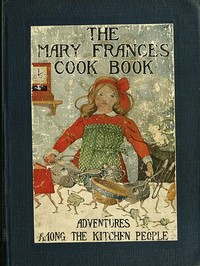
In this 1912 hybrid of storybook and cookbook, kitchen utensils come to life to teach a girl named Mary Frances how to cook. The excerpts show a talking rolling pin, a quarrelsome saucepan, and recipes woven into a narrative where the 'Kitchen People' are both instructors and characters.
Read the complete public-domain text at its original source.
Read on Project GutenbergThe Mary Frances Cook Book, published in 1912, presents itself as a story about a girl whose ambition to help her mother leads her into conversations with animated kitchen utensils. The author’s preface frames the book as a 'Book within a Book' that introduces Mary Frances to 'Aunty Rolling Pin' and other 'Kitchen People.' The catalog subjects classify it as juvenile fiction and a cookbook, but the excerpts reveal a more specific blend: recipes are embedded in a narrative where utensils speak, sing, and even argue. For instance, Sauce Pan feigns sleep to avoid being used, and Aunty Rolling Pin recites flour-themed poetry. The book’s structure alternates between chapters of story and lists of recipes, with the story chapters often demonstrating the recipes in action.
Talking Utensils and Recipe Integration
The excerpts show that the 'Kitchen People' are not merely decorative; they actively teach cooking techniques. In the Thimble Biscuits episode, Aunty Rolling Pin gives step-by-step instructions—sifting flour three times, rubbing butter with fingertips, and using a thimble as a cutter—while Mary Frances follows along. The dialogue is playful: Aunty Rolling Pin puns on 'floury' for 'flowery,' and Mary Frances giggles. This integration of instruction into conversation is consistent throughout the excerpts. The recipes are not separate from the story; they are the story’s action. For example, when Mary Frances makes cocoa, she reads the recipe aloud, and Sauce Pan’s reluctance to cooperate becomes a minor conflict. The book thus teaches cooking through a fictional framework where the tools have personalities and opinions.
The Narrative Frame and Its Limits
The preface claims that Mary Frances 'emerged no longer a little girl, but a real little woman' after three weeks of adventures. However, the excerpts do not show this transformation; they show her learning specific tasks like making biscuits and cocoa. The catalog subject 'Mary Frances (Fictitious character) -- Juvenile fiction' suggests a character-driven story, but the excerpts focus more on the recipes and the utensils’ antics than on Mary Frances’s development. The chapter titles—'The Kitchen People,' 'Toaster Man,' 'The Pot-and-Kettle Fight'—indicate a series of encounters, but the provided text only includes the biscuit and cocoa scenes. The book’s claim of a 'Book within a Book' (the mother’s recipe collection) is mentioned but not elaborated in the excerpts. Readers should expect a loose narrative that prioritizes cooking lessons over plot progression.
Voice and Instructional Style
The excerpts reveal a distinctive voice: the utensils speak in a colloquial, sometimes bossy tone. Aunty Rolling Pin says, 'Rub lightly with your finger tips. That’s it—pour the milk gradually,' blending instruction with encouragement. Sauce Pan’s dialogue—'Don’t bother me. I’m asleep'—adds humor. The recipes themselves are numbered and formatted as lists, but within the story they are read aloud or referenced. The instructional style is direct and assumes a young audience: 'In order to get the baking powder into every bit of the flour, they should be sifted together three times.' The book also includes practical tips, like using folded paper to pour flour into a sifter. This combination of narrative and recipe suggests the book was designed to make cooking appealing through personification, though the excerpts do not indicate whether all utensils speak or only some.
Readers approaching this book should be prepared for a work that is neither pure fiction nor pure cookbook. The story chapters advance the cooking lessons, and the recipe lists provide reference. The excerpts suggest that the book’s charm lies in the personification of kitchen tools, but the narrative is thin. For a full understanding, one would need to read the complete text to see how the 'Kitchen People' are introduced and whether Mary Frances’s character develops beyond her initial eagerness. The book is best suited for those interested in early 20th-century children’s literature or historical approaches to teaching domestic skills.
The rain made the kitchen feel like a closed book, and I reread The Mary Frances Cook Book until the saucepans’ quarrels felt like old friends. That odd tenderness for voices arguing in small rooms lingered. It led me, almost accidentally, to Harvard Stories: Sketches of the Undergraduate — A Reader’s Guide, where young men bicker and boast with similar warmth. Different world, same quiet fondness for the noise of belonging.
There are no reviews for this eBook.
There are no comments for this eBook.
Reader reflection
Your personal reading reflection
Build a private reading journal entry for this title.
Your progress
0
/
10
2
How did the book work for you overall?
3
Is this a title you would suggest to others?
4
Did the language feel accessible?
5
Did anything about the book feel genuinely new?
6
Did the book give you something worth debating?
7
Could you apply anything you learned?
8
Was the book moving at the right speed?
9
In one sentence, what did you learn?
10