1

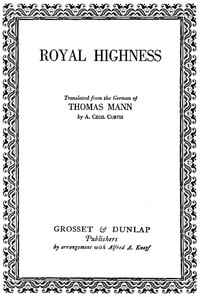
Royal Highness — Reading Companion
(0 User reviews)
329
Project Gutenberg
2011
Not confirmed
Germany -- Fiction; German fiction -- Translations into English; Courts and courtiers -- Fiction
Readers of public-domain and historical texts
Project Gutenberg digital edition
en
Edition facts
Words
121,296
Reading time
528 min
Text sections
10
This digital edition of Royal Highness — Reading Companion is described by source-level measurements including 121,296 words, 8 hr 48 min estimated reading time, and 10 detected text sections.
The text analysis averages about 22.7 words per sentence, while the detected sections provide another way to judge how the source is divided.
Project Gutenberg metadata also associates the work with “Germany -- Fiction,” connecting these edition facts with the source record’s subject description.
Source:
Project Gutenberg record #36028
Thomas Mann's novel about a German principality's court, focusing on Prince Klaus Heinrich's constrained life and his encounter with the American heiress Imma Spoelmann, whose family fortune contrasts with the court's faded grandeur.
Read the complete public-domain text at its original source.
Read on Project GutenbergThe novel opens on the Albrechtstrasse, the main artery of the capital, with a meticulously described encounter between a general and a young lieutenant. The narrator's voice is ironic and omniscient, immediately establishing a tone of detached observation. The scene is set in a 'dull and sober light' that robs the street of 'all mystery, all individuality,' hinting at the stifling atmosphere of the court. The lieutenant, with 'narrow shoulders' and 'blue rather tired-looking eyes,' is identified as Prince Klaus Heinrich, the younger son of the reigning grand duke. The general's exaggerated deference and the narrator's commentary on 'natural organization' and 'hierarchical gulf' signal that this is a world governed by rigid protocol, where even a simple meeting is a ritualized performance.
The Constriction of Court Life
The first chapter, titled 'The Constriction,' lives up to its name. The prince's existence is hemmed in by ceremony and expectation. The narrator describes his daily routine with a mixture of sympathy and irony: 'He had to learn to sit still, to bow, to smile, to speak in a low voice.' The physical details—the heavy uniforms, the echoing corridors of the Old Schloss, the constant presence of attendants—create a sense of suffocation. The prince's older brother, Albrecht, is the heir, but he is sickly and reclusive, leaving Klaus Heinrich as the public face of the monarchy. Yet even this role is scripted; he is a 'representative' rather than a person. The novel's early pages establish a central tension: the individual versus the institution, the human being versus the symbol.
The Arrival of the Spoelmann Fortune
Midway through the excerpts, the narrative shifts to the American millionaire Samuel Spoelmann and his daughter Imma. The tone changes, becoming almost journalistic as the narrator recounts the Spoelmann family history through the lens of a local newspaper, the Courier. The story of Spoelmann senior's rise—from a 'Blockhead Farm' to a fortune of 'a round thousand million marks'—is told with a mixture of awe and irony. The narrator notes that Samuel Spoelmann 'did not deserve the hatred of the out-distanced competitors,' but his wealth isolates him as surely as Klaus Heinrich's rank. The Spoelmanns are outsiders, their American pragmatism clashing with European tradition. Imma, described as 'that wonderful blood-mixture of a girl,' is introduced as a figure of mystery, her name 'a real German name' but her background thoroughly transatlantic.
Contrasting Worlds: Court and Commerce
The excerpts juxtapose two worlds: the stagnant court and the dynamic Spoelmann enterprise. The court is defined by 'rules and prescriptions,' where even a general's walk is 'slow deliberation.' In contrast, the Spoelmann fortune is built on risk and movement—railways, steel, petroleum. The narrator's language reflects this: the court scenes are static, filled with descriptions of uniforms and architecture, while the Spoelmann narrative is active, full of verbs like 'bought,' 'leased,' 'floated,' and 'dominated.' Yet both worlds are governed by hierarchy. The court's hierarchy is inherited and ceremonial; the Spoelmanns' is financial and achieved. The novel seems to ask which is more oppressive. The prince's encounter with Imma, hinted at in the chapter title 'Imma,' promises a collision of these two systems.
The Narrator's Ironic Voice
Throughout the excerpts, the narrator maintains a distinctive ironic distance. The opening scene is described as 'surprising, painful, delightful, and topsy-turvy,' yet nothing actually happens—the general simply salutes the prince. This gap between expectation and event is a recurring technique. The narrator also intrudes with rhetorical questions ('Can this rencontre lead to any complication?') and commands ('Natural organization, take thy course!'), creating a playful, almost theatrical tone. In the Spoelmann sections, the irony is gentler, directed at the Courier's 'delicacy' and the absurdity of inherited wealth. This voice prevents the novel from becoming a mere social satire; it remains a comedy of manners, but one with a sharp edge. The reader is never allowed to forget that they are being told a story, and that the teller has opinions.
As you read Royal Highness, pay attention to the way Mann uses physical details—a uniform, a gesture, a piece of furniture—to convey psychological states. The novel is less concerned with plot than with atmosphere and character. The excerpts suggest that the meeting between Klaus Heinrich and Imma Spoelmann will be a confrontation between two forms of isolation: the prince trapped by birth, the heiress trapped by wealth. The narrator's ironic commentary will guide you through this encounter, but the real drama lies in the small, telling moments of human connection.
Reading about Klaus Heinrich’s gilded cage brought back an afternoon in my grandfather’s study, dust motes floating over his tired biography of a minor duke. That same quiet ache of unused potential crept through Half-Hours with the Idiot — Background and Themes, where brilliance hides behind a curtain of folly. Strange how two different stories can share one lonely, waiting heart.
There are no reviews for this eBook.
There are no comments for this eBook.
Reader reflection
Your personal reading reflection
Build a private reading journal entry for this title.
Your progress
0
/
10
2
Did this book hold your interest?
3
How likely are you to recommend this book?
4
What was the reading difficulty like?
5
Would you start a conversation about this book?
6
Could you see yourself revisiting this book?
7
How well did it match your expectations?
8
What did you think about the pace?
9
What did this book teach you most?
10