1

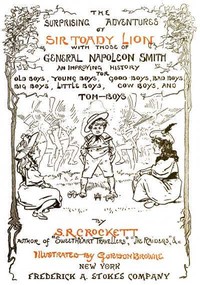
The Surprising Adventures of Sir Toady Lion with Those of General Napoleon Smith An Improving History for Old Boys, Young Boys, Good Boys, Bad Boys, Big Boys, Little Boys — Text and Context
(0 User reviews)
784
Project Gutenberg
2012
Not confirmed
Fantasy literature; Conduct of life -- Juvenile fiction; Love stories; Adventure stories; Friendship -- Juvenile fiction; Boys -- Juvenile fiction; Siblings -- Juvenile fiction; Wit and humor, Juvenile; Youth -- Conduct of life -- Juvenile fiction; Soldiers -- Juvenile fiction; Battles -- Juvenile fiction; Castles -- Juvenile fiction
Readers of public-domain and historical texts
Project Gutenberg digital edition
en
Edition facts
Words
70,681
Reading time
308 min
Text sections
10
This digital edition of The Surprising Adventures of Sir Toady Lion with Those of General Napoleon Smith An Improving History for Old Boys, Young Boys, Good Boys, Bad Boys, Big Boys, Little Boys — Text and Context is described by source-level measurements including 70,681 words, 5 hr 8 min estimated reading time, and 10 detected text sections.
The text analysis averages about 17.9 words per sentence, while the detected sections provide another way to judge how the source is divided.
Project Gutenberg metadata also associates the work with “Fantasy literature,” connecting these edition facts with the source record’s subject description.
Source:
Project Gutenberg record #39340
S. R. Crockett's 1897 children's novel follows the military campaigns and domestic scrapes of Hugh John, his younger brother 'Sir Toady Lion,' and their sister Prissy, set in a Scottish border village. The story balances mock-heroic battles, sibling rivalries, and the practical ethics of childhood, with a distinctive narrative voice that shifts between grandiloquent parody and precise observation of juvenile behavior.
Read the complete public-domain text at its original source.
Read on Project GutenbergThe novel opens with a dedication that warns off 'Too Good Boys' and immediately establishes its playful, combative tone. The first chapter introduces three siblings—Prissy, Hugh John, and the youngest, nicknamed Sir Toady Lion—whose domestic life is a constant negotiation of power, mischief, and loyalty. Crockett's narrator adopts a mock-heroic register, describing childhood squabbles with the vocabulary of military campaigns and chivalric romance, yet the dialogue and details remain firmly rooted in the specific textures of late-Victorian rural childhood.
The excerpts reveal a world where a half-crown gift prompts a philosophical disquisition on the uses of money, where a girl's practical nursing of a dog is juxtaposed with a boy's theft of missionary pennies, and where the landscape—from dusty roads to gipsy encampments—is as much a character as the children. The author's eye for the physicality of childhood—Toady Lion sitting down 'just wherever he happened to be at the time'—grounds the narrative in concrete, often comic, observation.
Mock-Heroic Language and Juvenile Scale
Crockett's most consistent stylistic device is the application of grand military and historical language to the small-scale dramas of children. The chapter titles alone—'Declaration of War,' 'First Blood,' 'Mobilisation,' 'The Battle of the Black Sheds'—signal this persistent irony. The frontispiece caption, 'As the Highlanders had Clung to the Cavalry Stirrups at Balaclava,' further aligns the children's adventures with famous military engagements.
This technique does more than amuse; it gives weight to the children's own perceptions. When Hugh John becomes 'General Napoleon Smith,' the title is not merely a joke but a reflection of his earnest self-image. The narrator treats the children's conflicts with the same seriousness they themselves feel, while the adult reader is invited to see the gap between the grandiloquent frame and the actual stakes—a lost battle over a horsepond, a siege of a garden shed.
The effect is a double perspective: the children are both genuinely heroic within their own world and comically miniature from the outside. Crockett sustains this balance without condescension, allowing the reader to occupy both viewpoints simultaneously.
The Moral Economy of Childhood
The excerpts offer a concentrated look at how the children negotiate rules, authority, and their own ethical codes. Toady Lion's monologue on money is a miniature treatise: he distinguishes between 'money that you get gived you' (locked away by Janet), 'miss'nary money' (accessible via a 'slimmy-jimmy knife'), and the ideal future of 'gold sixpences and fings' in one's own pockets. This taxonomy reveals a child's logic—practical, opportunistic, and only partly aligned with adult morality.
Similarly, Cissy Carter's encounter with Billy Blythe shows a different moral calculus. She treats the dog without asking about its owner's legal standing; Billy's companions warn him that telling 'the beak's daughter' his name could mean 'thirty days.' Yet Billy trusts her because she didn't use the word 'sneaked'—a subtle distinction in the children's own code of honor. The novel thus presents a world where adult rules (Janet's locked money-box, the magistrate's authority) coexist with a parallel juvenile system of trust, risk, and reward.
Voice and Dialogue as Character Markers
Crockett differentiates his young characters sharply through their speech patterns. Toady Lion's dialogue is rendered with consistent phonological spelling ('Oo! what 'oo fink?', 'yots of fings', 'rubbage, I fink'), marking him as the youngest and most physically impulsive. His speech is a stream of consciousness, full of digressions and physical actions ('Toady Lion sat plump down in the thickest dust of the road').
In contrast, Cissy Carter speaks in complete, practical sentences: 'There, that will keep him from biting at it, and you must see that he doesn't scratch off the bandage.' Her language is efficient and authoritative, befitting her role as the competent older girl. Hugh John, glimpsed through his sister's references and his own actions, occupies a middle ground—old enough to lead military games but still subject to adult discipline.
The narrator's own voice shifts between formal period prose and colloquial asides, creating a texture that is both literary and immediate. This variety in register keeps the narrative lively and prevents the mock-heroic frame from becoming monotonous.
Readers approaching The Surprising Adventures of Sir Toady Lion should attend to the interplay between the children's earnest self-seriousness and the narrator's wry framing. The novel rewards attention to its linguistic play—the way Toady Lion's baby talk contrasts with Prissy's measured tones, or how a description of a dog's bandage can carry the same weight as a battle plan. Crockett's achievement is to take childhood seriously without sentimentalizing it, and to find genuine drama in the small, specific world of a Scottish village at the turn of the century.
Reading about Sir Toady’s earnest little campaigns, I found myself thinking of that other domestic kingdom, where recipes are battles and spills are treaties. It made me wonder if all childhood rulebooks hide a similar tender logic. There is a particular comfort in that thought, like finding crumb trails in a familiar kitchen. The Mary Frances cook book — A Closer Reading shares that same quiet earnestness, a world ordered through small rituals.
There are no reviews for this eBook.
There are no comments for this eBook.
Reader reflection
How did this book work for you?
Your answers remain private and are stored only in this browser.
Your progress
0
/
10
2
How did the book work for you overall?
3
Would you recommend this book to another reader?
4
Did the language feel accessible?
5
Would this book work well in a reading group?
6
How would you describe its reading pace?
7
Would a second reading be valuable?
8
How useful were the ideas in this book?
9
What is the main idea you are taking away?
10