1

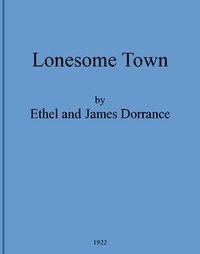
Lonesome Town — Key Ideas to Explore
(0 User reviews)
1136
Project Gutenberg
2011
Not confirmed
New York (N.Y.) -- Fiction; Love stories; Mystery fiction; Ranchers -- Fiction
Readers of public-domain and historical texts
Project Gutenberg digital edition
en
Edition facts
Words
83,431
Reading time
363 min
Text sections
30
The catalog record for Lonesome Town — Key Ideas to Explore provides practical reading context through 83,431 words, 6 hr 3 min estimated reading time, and 30 detected text sections.
The text analysis averages about 16.4 words per sentence, while the detected sections provide another way to judge how the source is divided.
Project Gutenberg metadata also associates the work with “New York (N.Y.) -- Fiction,” connecting these edition facts with the source record’s subject description.
Source:
Project Gutenberg record #35819
A Montana rancher travels to New York City, where his Western directness collides with urban intrigue and a blind father's poignant request to describe his daughter's face, using Yellowstone geysers and cliffs as similes.
Read the complete public-domain text at its original source.
Read on Project GutenbergThe novel opens with Why-Not Pape, a Montana rancher, pausing his lathered horse in a gorge, his appearance and manner immediately signaling a man out of his element. The narrative voice is distinctive—colloquial, knowing, and slightly arch, as when it introduces Pape with a wry aside: “But don’t expect to understand—not at first hand grasp—how one christened Peter Stansbury Pape some thirty-odd years before, had come by his interrogatory sobriquet.” This tone, blending Western vernacular with a narrator who addresses the reader directly, sets the stage for a story that moves between the open range and the confined spaces of New York City.
A Westerner in the City
The excerpts show Pape arriving in New York, where his physical description—chaps, flannel shirt, white sombrero—marks him as an outsider. The narrative emphasizes his discomfort: he is “not at first hand grasp” to those around him. The city is presented as a place of hidden motives and indirect communication, contrasting with the directness of the West. Pape’s interactions are tinged with suspicion; he feels “as nearly futile as was constitutional about further attempts to convince her of his fealty.” The urban setting is not described in detail but is felt through the tension it creates in Pape, who must navigate social codes he does not fully understand.
The Blind Father’s Request
A key scene involves a blind father asking Pape to describe his daughter Jane’s face. The father, a former Western explorer who helped name the Yellowstone region, prompts Pape to use natural similes: Jane’s eyes are like “Morning Glory Geyser,” her hair like “the jade of Obsidian Cliffs.” This moment is structurally significant—it bridges the Western landscape with the Eastern drawing room, and it forces Pape to articulate his admiration in a language both men share. The father’s blindness also introduces a motif of unseen truths: Pape’s feelings, Jane’s appearance, and the mysteries of the plot are all things that must be inferred or described rather than directly seen.
Recurring Images of Light and Shadow
The excerpts are marked by contrasts of light and dark. The opening trail “spilled into a pool of shadows,” and later the father gives a “sightless glance” toward a door. Pape’s description of Jane’s eyes recalls the “sun that whitened the Glory’s spray” and the “deeps of its pool a stronger blue.” These images suggest a world where clarity is elusive, and characters must rely on indirect perception. The narrator’s own voice shifts between blunt statement and playful evasion, as when it winks at the reader through a bull snake. This pattern of revelation and concealment is central to the novel’s structure, which moves between action and introspection.
Movement Between Scenes
The novel’s structure is built on abrupt transitions: from a Montana gorge to a New York parlor, from physical action to quiet conversation. The excerpts show Pape in motion—riding hard, then pausing; entering a room, then leaving. The chapter titles hint at a plot involving mystery (“The Sky Sign,” “Double Focus”) and romance (“Just Au Revoir”), but the excerpts focus on the spaces between events: the moments of waiting, remembering, and describing. This emphasis on movement and pause gives the narrative a rhythmic quality, as if the story itself is catching its breath before the next rush of action. The reader is invited to attend to these intervals, where character and setting are revealed.
Readers attentive to the novel’s structure will notice how the Western landscape persists as a reference point even in the city, and how the blind father’s request to “see” through words becomes a model for the narrative’s own method. The story rewards those who watch for the interplay of light and shadow, and who listen for the narrator’s wry asides. Approach the text as a series of scenes linked by movement and memory, rather than a straightforward plot.
There are no reviews for this eBook.
There are no comments for this eBook.
Reader reflection
What did you think of this book?
Answer a few questions and save a private reflection on this device.
Your progress
0
/
10
2
Was reading this book enjoyable?
3
How likely are you to recommend this book?
4
What was the reading difficulty like?
5
How much did the book move you?
6
Did you relate to its people, ideas, or situations?
7
Did you gain anything practical from the text?
8
Which part made the strongest impression?
9
What changed or sharpened your thinking?
10