1

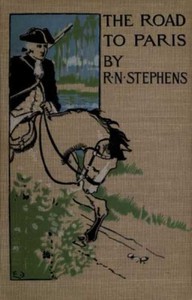
The Road to Paris: A Story of Adventure — Themes and Context
(0 User reviews)
90
Project Gutenberg
2011
Not confirmed
Historical fiction; United States -- History -- Revolution, 1775-1783 -- Fiction; Adventure stories
Readers of public-domain and historical texts
Project Gutenberg digital edition
en
Edition facts
Words
133,298
Reading time
580 min
Text sections
13
The Road to Paris: A Story of Adventure — Themes and Context can be approached with a clearer sense of reading commitment from its source measurements: 133,298 words, 9 hr 40 min estimated reading time, and 13 detected text sections.
The text analysis averages about 21.5 words per sentence, while the detected sections provide another way to judge how the source is divided.
Project Gutenberg metadata also associates the work with “Historical fiction,” connecting these edition facts with the source record’s subject description.
Source:
Project Gutenberg record #35488
An editorial note on the language, narrative voice, and shifts in pacing in Robert Neilson Stephens's 1898 historical adventure, drawing on excerpts from the protagonist's journey from the Maine wilderness to Bath society.
Read the complete public-domain text at its original source.
Read on Project GutenbergThe narrative voice in The Road to Paris shifts markedly between the opening wilderness march and the later Bath episodes. The early chapters adopt a collective, almost oral tone—'With our company of riflemen that marched in Arnold's army'—using a first-person plural that situates the reader among the soldiers. This communal voice gives way to a more conventional third-person limited perspective once the protagonist, Dick Wetheral, reaches England. The transition is not abrupt but signaled by a change in sentence rhythm: the long, clause-heavy descriptions of the Quebec expedition are replaced by shorter, more rapid sequences that mirror Dick's restless energy in Bath.
Voice and Register in the Wilderness
The opening excerpts show a narrator who is both participant and observer. Phrases such as 'Not a man of us made a jest' and 'so natural was her action' create a sense of shared experience, as if the storyteller was present. The register is plain and direct, with concrete details—'broke the thin ice coating with the butts of their guns'—that ground the adventure in physical reality. This voice avoids the ornate period diction common in late Victorian adventure fiction, instead favoring a reportorial clarity. The effect is to make the extraordinary seem matter-of-fact, a technique that lends credibility to the hardships described.
Pacing and the Compression of Time
Stephens manipulates pacing through temporal compression. In the Bath section, a single paragraph covers five months: 'the past five months had been so crowded with events and changes that they trailed out behind him like years.' The narrative accelerates by summarizing Dick's acquisition of French, fencing, and dancing lessons in a few sentences, then slows for a single evening's confrontation. This variation creates a rhythm of expansion and contraction, with the card game and the encounter with Squire Bullcott receiving extended treatment while longer periods are condensed. The effect is to emphasize moments of dramatic tension over the quotidian.
Dialogue and the Marking of Social Change
Dialogue in the excerpts serves to register shifts in social standing and linguistic register. Bullcott's outburst—'Why, by God, 'tis the rascal gamekeeper masquerading as a gentleman!'—uses a coarse, exclamatory style that contrasts with the polite exchanges at the Rooms. The narrator notes that Dick 'recognized the voice, now bellow and now whimper,' indicating a vocal instability that mirrors Bullcott's brutishness. In contrast, the fop's French passages mark a linguistic boundary that Dick must cross to ascend socially. The narrative thus uses speech patterns to delineate class and to track the protagonist's movement between worlds.
Readers attentive to narrative craft will note how Stephens uses the collective voice of the wilderness to establish authenticity, then shifts to a more conventional third person as Dick enters society. The compression of time in the Bath chapters, alongside the use of dialogue to signal social mobility, gives the novel a dual texture: one part chronicle, one part picaresque. The excerpts suggest that the book rewards attention to these shifts in pace and perspective.
That old Stephens book stayed with me mostly for its quiet shifts—how a journey through the wild can settle into a drawing room’s hush. It made me think of another novel, A Mere Chance: A Novel. Vol. 1 — Inside the Classic, where chance and pacing feel just as tender, leaving you with a strange, slow ache afterward.
There are no reviews for this eBook.
There are no comments for this eBook.
Reader reflection
How did this book work for you?
Your answers remain private and are stored only in this browser.
Your progress
0
/
10
2
What was your overall reaction to the book?
3
Would you pass this book on to a friend?
4
What was the reading difficulty like?
5
How strong was your personal connection to the text?
6
How useful were the ideas in this book?
7
How did the pace of the book feel?
8
How strongly did the book affect you emotionally?
9
Which lesson or insight stayed with you?
10