1

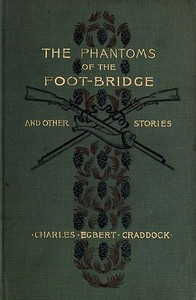
The Phantoms of the Foot-Bridge, and Other Stories — Edition Insights
(0 User reviews)
296
Project Gutenberg
2011
Not confirmed
Mountain life -- Fiction; Cumberland Mountains -- Fiction; Tennessee -- Social life and customs -- Fiction
Readers of public-domain and historical texts
Project Gutenberg digital edition
en
Edition facts
Words
98,079
Reading time
427 min
Text sections
11
This digital edition of The Phantoms of the Foot-Bridge, and Other Stories — Edition Insights is described by source-level measurements including 98,079 words, 7 hr 7 min estimated reading time, and 11 detected text sections.
The text analysis averages about 21.8 words per sentence, while the detected sections provide another way to judge how the source is divided.
Project Gutenberg metadata also associates the work with “Mountain life -- Fiction,” connecting these edition facts with the source record’s subject description.
Source:
Project Gutenberg record #36771
In these six stories set in the Cumberland Mountains, Charles Egbert Craddock renders the speech, superstitions, and moral tensions of Appalachian life, where ghostly foot-bridge crossings, moonshining at waterfalls, and a child's adoption expose fault lines between the living and the dead, duty and desire.
Read the complete public-domain text at its original source.
Read on Project GutenbergThe title story opens with a foot-bridge described as “a brace of logs, the upper surface hewn,” a flimsy structure that nevertheless bears the weight of rumor: “harnts an’ sech onlikely critters” have been seen crossing it. The mountaineer Roxby speaks with a “pride of the cicerone,” while his listener recoils, his own reasons for fearing death left unstated. This early exchange establishes a pattern across the collection: tangible, everyday settings—a bridge, a cabin, a blacksmith’s shop—become stages for encounters with the uncanny or the unresolved.
Voices of the Mountains
Craddock’s dialogue is dense with regional idiom and rhythm. Characters say “warn’t you-uns apologizin’ ter me fur not bein’ a nephew?” and “ye mustn’t be so turr’ble bad.” The drawl of the mountaineer is contrasted with a listener’s “low, repressed cadence,” marking social and emotional distance. In the excerpt from “His ‘Day in Court,’” the boy Leander confuses gender in titles of respect, calling the hunter Tyler Sudley “ma’am”—a habit that “were pathetic rather than ridiculous.” The narrator notes that Sudley had taught the child these words “in the forlorn hope of propitiating” his wife, revealing how language carries the weight of failed intentions.
Fault Lines in Kinship
Sudley’s memory of fetching the orphaned Leander on a snowy night is rendered in precise, sensory detail: the “white-covered wagon slowly a-creak,” the “bucket for water swaying beneath.” He had hoped the child would be “a free gift from the dead baby’s hands” to his grieving wife, but the plan backfired. The story traces the “morbid sensitiveness peculiar to a tender conscience” as Sudley wavers between self-blame and the stubborn sense that he “had not judged amiss.” This tension—between intended solace and actual estrangement—runs through the collection, where family bonds are often strained by death, duty, or misunderstanding.
The Supernatural as Social Fact
Ghosts in these stories are not mere atmosphere; they are treated as community knowledge. The foot-bridge is avoided because “harnts” cross it, and the question “Whose ‘harnts’?” is met with a list. The supernatural is woven into everyday speech and action, as when a character “stole noiselessly in the soft snow” or when a woman “flung her apron over her head” in distress. Craddock presents these beliefs without condescension, embedding them in the landscape—the gorge, the graveyard, the falls—so that the boundary between natural and uncanny remains deliberately porous.
Readers will find that Craddock’s strength lies in the accumulation of small, telling details—a hesitation, a misused word, a glance at a bridge. The stories reward attention to the cadence of speech and the weight of unspoken history. Approach them not as plot-driven tales but as studies in the friction between what people say, what they remember, and what they dare not name.
The ghost on that foot-bridge made me pause—how we carry our unfinished business like stones in our pockets. I thought of my grandmother's own hollow crossings, and of a winter I spent with Lonesome Town, where the quiet ache of place felt exactly this heavy. Lonesome Town — Key Ideas to Explore stayed with me, a whisper instead of a shout.
There are no reviews for this eBook.
There are no comments for this eBook.
Reader reflection
How did this book work for you?
Your answers remain private and are stored only in this browser.
Your progress
0
/
10
2
Did this book hold your interest?
3
Is this a title you would suggest to others?
4
What was the reading difficulty like?
5
How would you rate its originality?
6
What was the strongest part of the book?
7
How did the reading compare with what you expected?
8
Would you read this book again?
9
What is the main idea you are taking away?
10