1

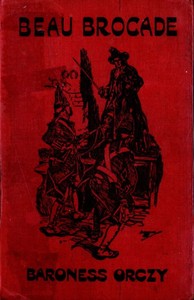
Beau Brocade: A Romance — Key Ideas to Explore
(0 User reviews)
133
Project Gutenberg
2012
Not confirmed
Historical fiction; Great Britain -- History -- 18th century -- Fiction; Brigands and robbers -- Fiction
Readers of public-domain and historical texts
Project Gutenberg digital edition
en
Edition facts
Words
78,003
Reading time
340 min
Text sections
11
For Beau Brocade: A Romance — Key Ideas to Explore, the stored edition analysis reports 78,003 words, 5 hr 40 min estimated reading time, and 11 detected text sections.
The text analysis averages about 17.8 words per sentence, while the detected sections provide another way to judge how the source is divided.
Project Gutenberg metadata also associates the work with “Historical fiction,” connecting these edition facts with the source record’s subject description.
Source:
Project Gutenberg record #39786
Baroness Orczy's 1912 romance set on Brassing Moor pits a mysterious highwayman against a squire's authority. The opening chapter's Act of Parliament reading, the forge setting, and a dance-trick betrayal reveal tensions between law, loyalty, and love. Excerpts show a wounded hero, a scornful heroine, and a stolen letter plot.
Read the complete public-domain text at its original source.
Read on Project GutenbergThe novel opens not with a character but with a public reading: a Royal Proclamation pinned to an old gallows-tree at a crossroads on Brassing Moor. The gaffers sigh; the young men wipe their hands on their breeches. No women are present—the roads are impassable after three days of rain. This is a world where law arrives by military escort and is posted on a relic of execution. The landscape itself—grey-green gorse, golden bracken, purple-stemmed bramble, and clumps of dark firs with 'gaunt arms stretched menacingly'—is a character in its own right, setting a tone of isolation and latent threat.
The forge of John Stich, introduced in the chapter titles, becomes a central meeting point. The novel's structure, divided into four parts (The Forge, The Heath, Brassington, H.R.H. the Duke of Cumberland), signals a movement from enclosed spaces to open heath and then to named locations and a historical figure. The excerpts reveal a romance built on mistaken identity, a stolen letter, and a dance that becomes a trap.
The Landscape as a Moral Barometer
The moor is not mere backdrop. Orczy invests it with emotional and moral weight. The opening description—'mile upon mile of grey-green gorse and golden bracken and long shoots of purple-stemmed bramble'—is precise and tactile. The heather is 'just bursting into bloom'; the firs have 'ruddy trunks.' This is a landscape observed with care, and it recurs as a space of flight, concealment, and confrontation.
Later, the wounded hero drags himself upright 'clinging to the bracken.' The heroine throws a purse 'on the ground before him.' The heath is where oaths are sworn and where the outlaw operates. The novel's title, Beau Brocade, suggests a figure who moves through this terrain with a certain style—'brocade' implying fabric, finery, perhaps disguise. The tension between the rough landscape and the elegant nickname is one of the book's quiet patterns.
Voice and Silence in the Dance Scene
The excerpt from the dance scene is a study in emotional asymmetry. The heroine speaks in a torrent of accusation: 'You ... you have duped and tricked me,' 'What price had his enemies set upon his head that you should sell it to them?' Her words are direct, repetitive, lashing. The hero, by contrast, speaks in fragments—'A poor wretch,' 'Madam! I swear by those sweet lips'—and is described as 'faint,' 'feebly,' 'scarcely able to speak.'
Orczy uses physical detail to underline the imbalance: he is 'ashy pale,' 'drawn with pain and weakness,' while she draws herself up 'to her full height.' The narrative voice sides with his suffering—'her words hurt him ten thousand times more than the wound in his shoulder'—but does not let her know it. The reader is placed in a position of privileged knowledge, watching a misunderstanding unfold in real time.
The Mechanics of Betrayal: Letters, Purse, and Oath
The plot turns on a set of concrete objects: letters, a purse, an oath. The heroine believes the hero has stolen letters that would save her brother's life. She offers him 'two hundred guineas' to return them. He protests ignorance: 'I know naught of those letters.' The purse is thrown, not given; the letters are stolen, not taken openly. Every transaction in this scene is failed or mistrusted.
The hero's oath—'I swear by those sweet lips of yours now turned in anger against me'—is both romantic and tactical. It binds his word to her body, a gesture that the narrative treats as sincere but which the heroine dismisses as 'a clever trick.' The novel seems to be building a pattern in which appearances are unreliable: the gallant highwayman may be a gentleman; the dance may be a trap; the faithful John Stich may or may not be a traitor. The reader is left to weigh evidence alongside the characters.
Readers coming to Beau Brocade should attend to the way Orczy uses physical space—forge, heath, dance floor—as arenas for moral and emotional conflict. The novel is structured in four parts, each with its own location and set of pressures. Pay attention to who speaks and who is silent, and to the objects (letters, purses, oaths) that carry the weight of the plot. The excerpts suggest a story less about action than about interpretation: what characters believe, what they misread, and what they are willing to swear to.
That dance-trick betrayal on Brassing Moor brought me back to my grandfather’s old armchair, where I once hid from rain with a borrowed book. The weight of law pressing on a warm heart felt achingly familiar. I remember reading Jasper Lyle years later and finding that same ache — loyalty tangled in secrets, love bruised by authority. Some moorland wind seems to carry it forever. Jasper Lyle — Inside the Classic stayed with me like a cold evening as it settles.
There are no reviews for this eBook.
There are no comments for this eBook.
Reader reflection
Your personal reading reflection
Build a private reading journal entry for this title.
Your progress
0
/
10
2
Was reading this book enjoyable?
3
Is this a title you would suggest to others?
4
How easy was the book to follow?
5
Could you apply anything you learned?
6
Is this a title worth rereading?
7
Did you relate to its people, ideas, or situations?
8
How original did the book feel?
9
What changed or sharpened your thinking?
10