1

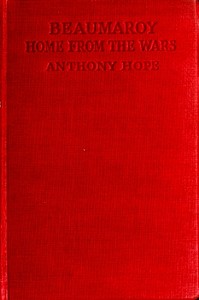
Beaumaroy Home from the Wars — Edition Insights
(0 User reviews)
1656
Project Gutenberg
2012
Not confirmed
England -- Social life and customs -- 20th century -- Fiction; World War, 1914-1918 -- Veterans -- Fiction; Mystery fiction; Women physicians -- Fiction
Readers of public-domain and historical texts
Project Gutenberg digital edition
en
Edition facts
Words
54,817
Reading time
239 min
Text sections
5
For Beaumaroy Home from the Wars — Edition Insights, the stored edition analysis reports 54,817 words, 3 hr 59 min estimated reading time, and 5 detected text sections.
The text analysis averages about 14.3 words per sentence, while the detected sections provide another way to judge how the source is divided.
Project Gutenberg metadata also associates the work with “England -- Social life and customs -- 20th century -- Fiction,” connecting these edition facts with the source record’s subject description.
Source:
Project Gutenberg record #39547
Doctor Mary Arkroyd takes in a mysterious paying guest, Beaumaroy, whose secretive behavior and an old man named Saffron suggest a hidden history tied to Morocco and the war. The opening excerpts reveal a broken engagement, a suspicious implement, and a growing medical curiosity that drives the narrative.
Read the complete public-domain text at its original source.
Read on Project GutenbergThe novel opens not with Beaumaroy but with Doctor Mary Arkroyd listening to her friend Cynthia recount a broken engagement. Cynthia’s fiancé, Captain Cranster, turned out to be already married—to a woman in Bogota. The story is told in breathless, colloquial dialogue, with dashes and interjections that convey Cynthia’s distress and Mary’s calm, probing questions. This conversational style establishes Mary as a perceptive listener, a quality that will serve her well when she later turns her attention to the enigmatic Beaumaroy.
By the second chapter, the focus shifts to Beaumaroy himself, a war veteran who becomes Mary’s paying guest. He cares for an elderly, reclusive man named Mr. Saffron, who lives in a cottage with a tower. Mary’s medical training and her growing suspicion about Saffron’s condition—she begins to suspect delusions of grandeur involving Morocco—drive the early intrigue. The excerpts show her piecing together clues: a combination knife-and-fork, a shawl worn in public, and cryptic references to “poems” that are actually speeches.
A Broken Engagement and a Suspicious Past
The first chapter introduces Mary Arkroyd through her friend Cynthia’s story of a narrowly avoided marriage to a bigamist. Cynthia’s account is peppered with details: the fiancé’s shell-shock claim, a dishonoured cheque, and a stepfather (the Colonel) who intervenes. The dialogue reveals Mary’s character—she asks pointed questions (“Were you very fond of him?”) but leaves Cynthia’s moral dilemma unexplored. This opening establishes a world where reputation and social appearances matter, and where hidden truths lurk beneath polite conversation.
The broken engagement also foreshadows the novel’s central mystery: what secrets does Beaumaroy carry? Cynthia’s fiancé was exposed by a bank refusing a cheque; Beaumaroy’s secret may be tied to Mr. Saffron’s strange behaviour. The parallel is subtle but suggestive: both men have pasts that threaten to unravel their present lives.
Doctor Mary’s Diagnostic Eye
Mary Arkroyd is a woman physician, a detail that shapes her perspective. In the excerpts, she applies clinical reasoning to Beaumaroy and Saffron. She notes the combination knife-and-fork—an implement that suggests Saffron cannot manage separate utensils, perhaps due to a physical or mental condition. She observes that Beaumaroy’s lie about the implement was betrayed by “a look in his eyes, a tell-tale mirth.” Her training leads her to suspect Saffron suffers from delusions of grandeur, possibly imagining himself a monarch or prophet connected to Morocco.
Mary’s internal monologue reveals her scepticism: she wonders how Beaumaroy will avoid actually travelling to Morocco, listing possible excuses (passport problems, new hieroglyphics). This analytical approach, combined with her emotional distance from the events, makes her a reliable but not omniscient narrator. The reader sees the mystery through her eyes, sharing her deductions and uncertainties.
The Tower Cottage and Its Secrets
The setting of Tower Cottage is crucial. It is isolated, with a tower that suggests a fortress or a prison. Mr. Saffron rarely leaves, and when he does, he wears a shawl—even in safe company. Mary interprets this as “secretiveness—perhaps fear.” The cottage becomes a stage for Beaumaroy’s careful management of Saffron’s delusions. The hieroglyphics Saffron waves are described as a “sheet of hieroglyphics,” and his shout about Morocco hints at a grand narrative he believes in.
The excerpts do not reveal what the hieroglyphics say or whether Saffron’s claims have any basis. But the physical details—the shawl, the knife-and-fork, the tower—create a vivid sense of a world governed by rules only Saffron and Beaumaroy understand. Mary’s intrusion into this world sets up a conflict between medical truth and the delicate fiction Beaumaroy maintains.
Morocco as a Key to Delusion
Morocco appears repeatedly as a reference point. Mary recalls that Morocco was “the starting-point of the years of crisis” before the war, linking Saffron’s obsession to real historical tensions. She imagines Beaumaroy’s supposed mission: to raise the Senussi, appear in Cairo, Jerusalem, Baghdad. This is not presented as fact but as Mary’s sardonic extrapolation. The word “Morocco” thus functions as a trigger for both Saffron’s delusions and Mary’s deductions.
The excerpts do not confirm whether Saffron’s beliefs are entirely baseless or whether Beaumaroy is exploiting them for his own ends. But the repeated references to Morocco—in Saffron’s shouts, in Mary’s thoughts—create a thematic thread. The novel seems to use Morocco as a symbol of distant, exotic possibility, contrasting with the mundane English setting. For a first-time reader, tracking every mention of Morocco may reveal how the mystery unfolds.
These excerpts offer a narrow window into the novel’s first third. The reader sees Mary’s perspective but not Beaumaroy’s motives or Saffron’s full story. Pay attention to how Mary’s medical training shapes her interpretations—she is both a detective and a doctor. The combination knife-and-fork, the shawl, and the hieroglyphics are concrete clues that may reappear. The novel’s title, Beaumaroy Home from the Wars, suggests that Beaumaroy’s war experience is central, though the excerpts only hint at it. Let the details guide your reading.
Reading about Doctor Arkroyd’s curiosity toward Beaumaroy’s hidden past stirred a memory of my own quiet evenings with a patient uncle, whose war stories always circled a locked drawer. Jasper Lyle gave me that same ache—wondering what secrets a person carries silently. Some books don’t explain mysteries; they simply let you sit beside them, waiting. Jasper Lyle — Inside the Classic felt like that, a warm, unhurried kind of wondering.
There are no reviews for this eBook.
There are no comments for this eBook.
Reader reflection
How will you remember this book?
Save your reaction, strongest insight, and memorable passage.
Your progress
0
/
10
2
What was your overall reaction to the book?
3
How likely are you to recommend this book?
4
How easy was the book to follow?
5
Was the book easy to understand?
6
Did this book create an emotional response?
7
Could you see yourself revisiting this book?
8
How well did it match your expectations?
9
In one sentence, what did you learn?
10