1

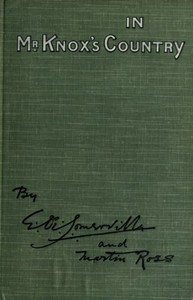
In Mr. Knox's Country — A Reader’s Guide
(0 User reviews)
531
Project Gutenberg
2011
Not confirmed
Ireland -- Social life and customs -- Fiction; British -- Ireland -- Fiction; Judges -- Fiction
Readers of public-domain and historical texts
Project Gutenberg digital edition
en
Edition facts
Words
71,857
Reading time
313 min
Text sections
7
This digital edition of In Mr. Knox's Country — A Reader’s Guide is described by source-level measurements including 71,857 words, 5 hr 13 min estimated reading time, and 7 detected text sections.
The text analysis averages about 19.2 words per sentence, while the detected sections provide another way to judge how the source is divided.
Project Gutenberg metadata also associates the work with “Ireland -- Social life and customs -- Fiction,” connecting these edition facts with the source record’s subject description.
Source:
Project Gutenberg record #38062
In this collection of interconnected stories, Somerville and Ross continue the misadventures of Flurry Knox and his circle in rural Ireland. The excerpts showcase the authors' comic timing, vivid landscapes, and sharp social observation, as characters navigate horse-trading, hunting, and domestic chaos.
Read the complete public-domain text at its original source.
Read on Project GutenbergThe opening of In Mr. Knox's Country drops the reader into a familiar Somerville and Ross scenario: a missed appointment at a crossroads. The narrator, an Englishman, is sent to find David Courtney in a landscape described with precise, quirky detail—a bohireen like “a series of bony elbows,” a cottage clinging “like a sea-anemone” to a rock. The deserted houses evoke Pompeii, but the humor is in the mundane: a window held up by a “great, speckled foreign shell.” This blend of the ordinary and the absurd sets the tone for the stories to follow.
The Art of the Delayed Entrance
The excerpts show a pattern of building anticipation through absence. In the first story, the narrator searches empty cottages before finding a trembling woman who ignores him. Later, in the hunting episode, the “hare” is a torn paper trail, and the chase is repeatedly thwarted by false leads—white stones, daisies, dandelion puff-balls, and deliberately misleading country people. These delays are not obstacles to the plot but the plot itself. The authors wring comedy from the gap between expectation and reality: the narrator’s impatience, the horses’ idiotic behavior, and the riders’ frantic, often futile, efforts. The reader is invited to enjoy the chaos rather than the resolution.
Voice and Dialogue as Characterization
Dialogue in these excerpts does more than advance action; it defines character in a few words. Flurry Knox speaks in terse, practical commands: “which’ll you do, hold the horse or go look for him?” Sally Knox’s commentary is sharp and knowing: “Look at him now, running mute! He’s too cross to shout.” The narrator’s internal voice is wry and self-deprecating, as when he notes that Daniel, his horse, “was enjoying himself on the road, according to the idiotic manner of horses.” Even minor characters like Miss Larkie McRory get distinctive lines: “I’ll have the face worn off my watch looking at it if you don’t let us start soon!” The authors use dialect sparingly but effectively, as in “bohireen” and “scald-crow,” grounding the dialogue in the Irish setting without overwhelming the reader.
Landscape as Active Participant
The Irish countryside in these excerpts is not a passive backdrop but an active force. The hill is “spacious bare country” with “nothing on it taller than a thorn-bush”; the wind “whirling in our ears, snatching our voices away to infinity.” The landscape dictates the action: the bohireen’s “bony elbows” force the narrator to climb; the wind scatters the paper trail, causing checks and confusion. The authors also use landscape for comic effect, as when the narrator compares the deserted houses to Pompeii, or when the horses are deceived by “goose-feathers.” This is a world where nature and human folly are in constant, often hilarious, tension.
Structure: The Story Within a Story
The excerpts reveal a collection structured around episodes rather than a single narrative arc. Each story begins with a specific premise—a missing man, a paper hunt—and unfolds through a series of set pieces. The hunting episode, for example, is a self-contained farce with its own logic: the “scent” is paper, the hounds are riders, and the quarry is a horse sale. The authors rely on recurring characters (Flurry, the narrator, Sally Knox) to provide continuity, but each story can be read independently. This episodic structure allows Somerville and Ross to vary tone and pace, from the quiet tension of the opening search to the manic energy of the hunt. Readers should expect digressions and detours as the point, not the problem.
Approach In Mr. Knox's Country as a series of comic vignettes rather than a novel. Pay attention to the rhythm of the prose—the way Somerville and Ross build a sentence to a punchline, or let a description linger on an absurd detail. The humor is dry, observational, and often at the expense of the narrator’s dignity. If you enjoy the first story’s blend of landscape and misadventure, you will find more of the same in the later episodes.
I keep thinking about In Mr. Knox’s Country—how the chaos of hunting and horse-trading always folds back into something strangely tender, like laughter that softens a hard day. It reminded me of the quiet ache in Poor Relations — Text and Context, where family bonds fray and hold at once. Both left me sitting with that feeling long after closing the page.
There are no reviews for this eBook.
There are no comments for this eBook.
Reader reflection
What did you think of this book?
Answer a few questions and save a private reflection on this device.
Your progress
0
/
10
2
What was your overall reaction to the book?
3
Is this a title you would suggest to others?
4
How easy was the book to follow?
5
Did it raise ideas you would like to talk about?
6
Was the book what you thought it would be?
7
How would you rate its originality?
8
What was the strongest part of the book?
9
What did this book teach you most?
10