1

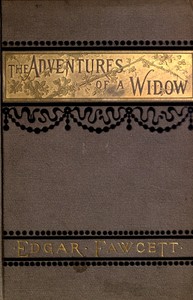
The Adventures of a Widow: A Novel — Themes and Context
(0 User reviews)
99
Project Gutenberg
2011
Not confirmed
Young women -- Fiction; Widows -- Fiction; Man-woman relationships -- Fiction; New York (N.Y.) -- Social life and customs -- 19th century -- Fiction
Readers of public-domain and historical texts
Project Gutenberg digital edition
en
Edition facts
Words
71,761
Reading time
313 min
Text sections
7
Before opening The Adventures of a Widow: A Novel — Themes and Context, the edition data offers a quick orientation: 71,761 words, 5 hr 13 min estimated reading time, and 7 detected text sections.
The text analysis averages about 14.1 words per sentence, while the detected sections provide another way to judge how the source is divided.
Project Gutenberg metadata also associates the work with “Young women -- Fiction,” connecting these edition facts with the source record’s subject description.
Source:
Project Gutenberg record #37185
Edgar Fawcett's 1884 novel follows a young widow navigating New York society, where a chance encounter on Bond Street and a flirtatious conversation about a fictional Bridget expose tensions between old-world charm and modern commerce, and between genuine feeling and social performance.
Read the complete public-domain text at its original source.
Read on Project GutenbergThe novel opens with a meditation on Bond Street, where the last conservative resident has been swept away by commerce. Fawcett uses this as a springboard to critique New York's indifference to its own past, noting that the city 'cares as little for the annals of her fine and stately growth as though, like Troy, she had risen, roof and spire, to the strains of magic melody.' This preoccupation with memory and loss sets the stage for a story about a young widow, Pauline, whose own history is similarly neglected or repackaged by those around her.
The excerpt then moves to a walk along the Battery, where Pauline and her companion Kindelon engage in a playful, ironic dialogue about a fictional shopgirl named Bridget. The banter is laced with social observation—Kindelon notes the beaux' 'soiled finger-nails' and ill-fitting coats—but is abruptly interrupted by the arrival of Courtlandt Beekman, Pauline's cousin. His appearance punctures the flirtatious mood, and Pauline's 'shrill, nervous laugh' and 'fluttered insecurity' suggest that more is at stake than mere cousinly affection.
The City as a Character
Fawcett devotes the opening paragraphs to New York's architectural and social history, personifying the city as a young, self-conscious entity that 'has so long looked over seas for all her history and romance' that she neglects her own. The Battery and Bowling Green are described as 'bathed in the tender glamour of Colonial association' yet 'frowned upon by the grim scorn of recent warehouses.' This tension between old and new mirrors the novel's central conflict: the widow Pauline must navigate a society that is simultaneously nostalgic and ruthlessly modern.
The description of Bond Street as a place where 'the last conservative resident' was 'relentlessly swept from that interesting quarter by the stout besom of commerce' establishes a pattern of displacement. The narrator's tone is elegiac but sharp, noting that 'few antiquarian feet tread her pavements' and that the city is 'too busy with her bustling and thrifty present.' This urban backdrop is not mere setting; it actively shapes the characters' interactions, as when Courtlandt Beekman emerges from the South Ferry, his 'big silver-knobbed stick' and 'yellow dogskin glove' marking him as a creature of commercial respectability.
The Performance of Innocence
Pauline's storytelling about the fictional Bridget reveals a sophisticated awareness of social roles. She constructs a detailed narrative of a shopgirl who 'emerges from her narrow little room in a tenement-house, brave and smart as you please' and distributes her smiles among beaux with 'soiled finger-nails.' Kindelon's interruptions—'Is there?' and 'And his finger-nails?'—expose the artifice, yet Pauline persists, insisting on details like the 'licorice cane' her ideal must twirl.
This exchange is a performance of naivety that both participants know is a game. When Courtlandt appears, the performance shatters. Pauline's 'shrill, nervous laugh' and her question 'what on earth I am doing here' betray a loss of control. Courtlandt's response—'It's very evident that you are taking a stroll with Mr. Kindelon'—is delivered with 'cool light of his eye' and a tone of 'neutral civility.' The contrast between Pauline's earlier playful banter and her sudden fluster underscores the precariousness of her social position as a widow, where even innocent walks are subject to scrutiny.
Silence and Subtext in Dialogue
Fawcett's dialogue is notable for what is left unsaid. When Kindelon asks, 'is not this gentleman coming toward us your cousin?' Pauline does not answer; she merely 'perceptibly colored.' The narrator then notes that 'Pauline did not answer, for she had already caught sight of Courtlandt.' This evasion is a small but telling detail—she cannot bring herself to confirm the relationship, perhaps because it complicates her flirtation with Kindelon.
Similarly, Courtlandt's speech is clipped and factual: 'I had some business with a man over in Brooklyn, and took this way back to my office.' He offers no explanation for why he is in the same location as Pauline and Kindelon, and his invitation to 'be off' is abrupt. Pauline's final line—'Can't I take you to your office, Court?'—is met with a curt refusal. The exchange is laden with unspoken tensions: jealousy, suspicion, and the constraints of propriety. Fawcett lets the silences speak louder than the words, inviting the reader to read between the lines of these carefully mannered encounters.
Readers attentive to the novel's opening will find that Fawcett's interest in surfaces—of buildings, of manners, of speech—is not superficial. The widow's 'adventures' are as much about the city's changing face as about her own. Pay close attention to the way characters describe others: their observations often reveal more about themselves. The novel rewards a slow reading that savors its ironic asides and its quiet, precise observations of a society in transition.
The rain made Bond Street feel like a stage set, and Fawcett’s widow moved through it with such careful grace that I paused, thinking of how we all perform our grief. Later, by the window, I picked up Out of the Air — Edition Insights almost absently, and the same quiet question surfaced—what passes between people when no one is watching.
There are no reviews for this eBook.
There are no comments for this eBook.
Reader reflection
Record your reading impressions
A brief reflection can help important ideas stay with you longer.
Your progress
0
/
10
2
Was reading this book enjoyable?
3
How likely are you to recommend this book?
4
How demanding did the text feel?
5
How clear did the writing feel?
6
Would you like to discuss this book with someone?
7
How much did the book move you?
8
How did the pace of the book feel?
9
Which lesson or insight stayed with you?
10