1

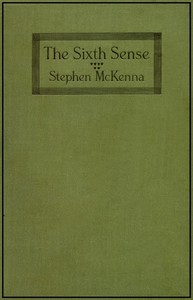
The Sixth Sense: A Novel — Background and Themes
(0 User reviews)
37
Project Gutenberg
2011
Not confirmed
Political fiction; England -- Social life and customs -- 20th century -- Fiction; Extrasensory perception -- Fiction; Women -- Suffrage -- Great Britain -- Fiction
Readers of public-domain and historical texts
Project Gutenberg digital edition
en
Edition facts
Words
86,651
Reading time
377 min
Text sections
10
Before opening The Sixth Sense: A Novel — Background and Themes, the edition data offers a quick orientation: 86,651 words, 6 hr 17 min estimated reading time, and 10 detected text sections.
The text analysis averages about 13.9 words per sentence, while the detected sections provide another way to judge how the source is divided.
Project Gutenberg metadata also associates the work with “Political fiction,” connecting these edition facts with the source record’s subject description.
Source:
Project Gutenberg record #37164
An editorial note on Stephen McKenna's 1915 novel, focusing on how the opening, middle, and later excerpts guide a first reading through its narrator's detached perspective, social satire, and the titular 'sixth sense' as a plot device.
Read the complete public-domain text at its original source.
Read on Project GutenbergThe narrator's first words—'I paused, with my foot on the lowest step of the Club'—establish a tone of measured observation that persists throughout the excerpts. Returning to London after twenty years, he catalogues changes in Pall Mall with a detached, almost anthropological eye: the old War Office gone, the Automobile Club 'new and unassimilated,' the Athenaeum painted an unfamiliar green. This opening immediately signals a novel concerned with social surfaces and the gap between past and present. The narrator's confession that 'it has always been a matter of indifference to me where I live, what I do, whom I meet' suggests a protagonist who observes rather than participates—a stance that will shape how readers encounter the conflicts to come.
A Narrator Who Stands Apart
The prologue's epigraph from Browning's 'Bishop Blougram's Apology'—'I'm at ease now, friend; worldly in this world, / I take and like its way of life'—prepares readers for a narrator who is comfortable but disengaged. His description of London traffic as 'as dangerous as the railway stations of America' reveals a wry, comparative intelligence. He wonders how long it will take to 'get used to the London of 1913,' and whether he will find 'anything to keep me long enough to grow acclimatised.' This restless, cosmopolitan detachment is the lens through which the novel's social world will be filtered. Readers should note how this narrative voice colours every scene: the narrator is present but not fully invested, a witness rather than a protagonist. The excerpts do not reveal his name or backstory, but his tone—cool, ironic, slightly weary—is consistent across the opening and later chapters.
The Social Game at Henley
Chapter VIII offers a sustained example of the novel's satirical treatment of Edwardian society. The narrator's account of Henley Regatta is laced with class-conscious irony: he admits to being 'every inch as much a snob as my neighbour' and regrets that Henley has become 'so deeply democratised.' His houseboat party on the 'Desdemona' is described as a 'Mad Hatter's luncheon' where guests come and go at will, and the conversation degenerates into 'a fantastic Burke's Auction Bridge'—a game of social one-upmanship where 'two earls counted higher than three viscounts.' The presence of a 'watchful Roden bodyguard' hints at political tensions beneath the leisure. This section demonstrates McKenna's skill at using social events to expose character and conflict. The narrator's role as host allows him to observe without fully engaging, maintaining his detached perspective even as the plot thickens around him.
The Sixth Sense as Plot Device
The novel's title appears in the table of contents as Chapter XII: 'The Sixth Sense.' While the excerpts do not include this chapter, the phrase recurs in dialogue. In one scene, a character named Sylvia tells the Seraph, 'Innocent women don't get into those positions,' and the Seraph replies, 'How do you prove her guilt?' This exchange, set against a backdrop of political agitation and women's suffrage, suggests that the 'sixth sense' may refer to intuition or extra-sensory perception in matters of justice and reputation. The catalog subjects list 'extrasensory perception' and 'women—suffrage' as themes, and the novel's subtitle is 'A Novel'—not a genre work. Readers should watch for how this sixth sense operates: is it a literal ability, a metaphor for social instinct, or something else? The excerpts leave this ambiguous, but the title chapter's placement late in the book implies it will be a key revelation.
Political Undercurrents and Personal Stakes
The excerpts hint at a political dimension that grows more prominent as the novel progresses. The prologue mentions 'the New Militants' and the need for Cabinet Ministers' families to have 'a lynx-eyed, heavy-booted, plain-clothes escort.' At Henley, the narrator notes that Gartside is 'kept in town discussing Governorships with the India Office,' and the Roden family's bodyguard suggests they are political targets. The dialogue between Sylvia and the Seraph revolves around a woman's guilt or innocence, possibly linked to the suffrage movement. The narrator's detachment may be tested as these political currents draw him in. Readers should attend to how personal relationships—especially those involving the Seraph, Sylvia, and Lady Roden—intersect with the broader social and political conflicts. The excerpts do not resolve these threads, but they establish a world where private loyalties and public causes are increasingly entangled.
Readers approaching The Sixth Sense for the first time will benefit from attending to the narrator's distinctive voice and his role as an observer. The excerpts suggest a novel that balances social satire with a mystery—perhaps a crime, perhaps a question of character—that the title promises to illuminate. The political and suffragist elements are woven into the fabric of upper-class life, not treated as separate themes. By noting how the narrator's detachment shapes each scene, and how the title concept is hinted at but not explained, readers can engage with the novel as a layered exploration of perception, justice, and the masks of Edwardian society.
I’ve always found a quiet kinship between these two. Stephen McKenna’s narrator, watching through his peculiar sixth sense, holds people at arm’s length, much like the measured world of the Clintons, where honour keeps everyone politely apart. No dramas, just the gentle ache of restraint. A familiar warmth settles when I revisit both, like old friends who prefer silence. The Honour of the Clintons — Inside the Classic offers that same hushed, knowing perspective.
There are no reviews for this eBook.
There are no comments for this eBook.
Reader reflection
Take a moment to reflect on this book
Create a short personal record of your experience with this book.
Your progress
0
/
10
2
Was reading this book enjoyable?
3
Would you encourage someone else to read it?
4
What was the reading difficulty like?
5
How valuable was this book for your own interests?
6
Did any part of the book stay with you emotionally?
7
Could you see yourself revisiting this book?
8
Which aspect of the book did you value most?
9
In one sentence, what did you learn?
10