1

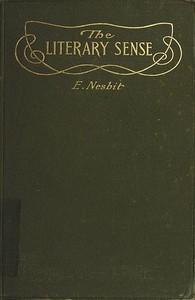
The Literary Sense — Inside the Classic
(0 User reviews)
973
Project Gutenberg
2012
Not confirmed
Man-woman relationships -- Fiction; England -- Social life and customs -- Fiction; Short stories, English
Readers of public-domain and historical texts
Project Gutenberg digital edition
en
Edition facts
Words
62,654
Reading time
273 min
Text sections
8
The Literary Sense — Inside the Classic can be approached with a clearer sense of reading commitment from its source measurements: 62,654 words, 4 hr 33 min estimated reading time, and 8 detected text sections.
The text analysis averages about 14.2 words per sentence, while the detected sections provide another way to judge how the source is divided.
Project Gutenberg metadata also associates the work with “Man-woman relationships -- Fiction,” connecting these edition facts with the source record’s subject description.
Source:
Project Gutenberg record #39324
E. Nesbit's 1903 story collection examines characters who self-consciously stage their lives as if they were fiction, revealing the gap between romantic literary ideals and mundane reality through precise, ironic observations.
Read the complete public-domain text at its original source.
Read on Project GutenbergThe opening story, 'The Unfaithful Lover,' immediately establishes the collection's central tension: a young woman regrets that her meeting with her lover will occur at Cannon Street Station rather than 'in some green, cool orchard.' She possesses, the narrator notes, 'the literary sense'—a tendency to measure real life against the conventions of poetry and cheap journals. This self-awareness, however, does not bring happiness; instead, it interrupts her emotions, just as watching herself cry in a mirror once stopped her tears. Nesbit's prose is coolly analytical, dissecting how characters script their own dramas while remaining blind to the actual consequences of their actions.
Theatrical Self-Consciousness
Throughout the excerpts, characters repeatedly observe themselves as if from outside. The heroine of 'The Unfaithful Lover' 'knew exactly how a tryst is conducted in the pages of the standard poets.' This meta-awareness is a recurring pattern: in another story, a character named Dick lies awake at three in the morning, 'gazing open-eyed into the darkness,' and mentally replays his own past decisions with theatrical self-accusation ('You beast, you brute, you hound!'). Nesbit often signals these moments with a shrug or a sigh, as when Dick 'shrugged his shoulders' before speaking. The narrative voice itself adopts a knowing, almost clinical tone, describing how 'the glow of conscious nobility had lasted a long while—nearly a week.' This framing suggests that the characters are not merely acting but are aware of their own performances, yet remain trapped within them.
Contrasts Between Setting and Sentiment
Nesbit repeatedly juxtaposes romantic expectations with drab urban settings. The lover in the first story wishes for 'May and the orchard, instead of January and the dingy, dusty waiting-room.' Her dress is 'brown, her jacket black, and her hat was home-trimmed'—a far cry from the 'white gown and green scarf' she imagines. Similarly, Dick recalls meeting Harriet Harcourt 'at a fancy-ball, and she wore the white-and-black dress of a Beardsley lady,' a deliberately artistic image that contrasts with the later, more sordid emotional entanglements. The collection's settings—Cannon Street Station, Highbury New Park, a sitting-room in Essex Court—are consistently ordinary, even banal, underscoring the gap between the characters' literary fantasies and their actual lives. This tension is not merely decorative; it drives the plot, as characters make decisions based on how a scene 'should' look rather than on genuine feeling.
The Cost of Noble Gestures
Several stories in the excerpts hinge on a character's decision to perform a self-sacrificing act that later reveals hidden selfishness. In 'The Unfaithful Lover,' Dick chooses to offer his friend Tom a job in Edinburgh rather than London, telling himself that 'both lovers would work better if they were not near enough to waste each other's time.' Yet he later admits, in the dark of night, that he 'wanted him out of the way.' The narrative traces the arc of this rationalization: the initial 'impulse to be, for once, really noble,' the 'glow of conscious nobility,' and then the slow, painful recognition of self-deception. Nesbit does not moralize; instead, she presents the thought process with precise detail, allowing the reader to see how easily altruism can mask ambition. The pattern recurs across stories, suggesting that the 'literary sense' is not just about aesthetics but about the stories people tell themselves to justify their choices.
Readers approaching The Literary Sense should attend to Nesbit's narrative voice, which often undercuts the characters' own perceptions. The stories reward attention to small gestures—a shrug, a sigh, a kiss described as 'studied brotherliness'—that reveal more than the characters intend. The collection is less about plot than about the gap between intention and action, and the ways in which self-awareness can itself become a form of blindness.
E. Nesbit’s people keep checking their own scripts, startled when life won’t follow the margins. I’ve carried that ache for years, and it surfaced again in a quiet stranger—Jane Oglander—Reading Companion, where pretending softens into something braver. The two volumes sit apart on my shelf, but they share a knowing, sidelong glance. Jane Oglander — Reading Companion keeps that company well.
There are no reviews for this eBook.
There are no comments for this eBook.
Reader reflection
Your personal reading reflection
Build a private reading journal entry for this title.
Your progress
0
/
10
2
Did this book hold your interest?
3
Would you recommend this book to another reader?
4
How easy was the book to follow?
5
Did you gain anything practical from the text?
6
Which aspect of the book did you value most?
7
How clearly were the main ideas presented?
8
Did you relate to its people, ideas, or situations?
9
Which lesson or insight stayed with you?
10