1


Dutch the Diver; Or, A Man's Mistake — Reading Notes
(0 User reviews)
70
Project Gutenberg
2011
Not confirmed
Adventure stories; Treasure troves -- Fiction; Deep diving -- Fiction
Readers of public-domain and historical texts
Project Gutenberg digital edition
en
Edition facts
Words
119,246
Reading time
519 min
Text sections
14
The catalog record for Dutch the Diver; Or, A Man's Mistake — Reading Notes provides practical reading context through 119,246 words, 8 hr 39 min estimated reading time, and 14 detected text sections.
The text analysis averages about 20.6 words per sentence, while the detected sections provide another way to judge how the source is divided.
Project Gutenberg metadata also associates the work with “Adventure stories,” connecting these edition facts with the source record’s subject description.
Source:
Project Gutenberg record #36724
An editorial note on George Manville Fenn's 'Dutch the Diver; Or, A Man's Mistake' (1870s), focusing on how the opening, middle, and later excerpts guide a first reading through character banter, diving tension, and a fraught rescue.
Read the complete public-domain text at its original source.
Read on Project GutenbergThe novel opens not with a plunge into the sea but with a quarrel over an office fire. The first chapter, 'At the Diver’s Office,' introduces two men—the younger, good-humoured Mr Pugh (nicknamed 'Pug' by the older) and the grizzled, stoking Rasp—whose bickering establishes a voice of rough camaraderie. Rasp, a veteran diver of forty years, complains of drafts and cold while Pugh tries to work at a drawing-board. Their exchange, peppered with dialect ('ketches,' 'sooperintended') and physical comedy (a poker wrested away), sets a tone of workplace friction that belies the dangerous profession they share.
Character Dynamics Through Dialogue
The excerpts reveal character primarily through speech. Rasp’s grumbling—'What’s the good o’ you saying will I leave the fire alone'—and his insistence on spelling 'Pugh' as 'Pug' show a man who values his own authority and experience. Pugh, in contrast, responds with laughter and patience, calling Rasp 'an obstinate old crab' but never losing his temper. This verbal sparring hints at a deeper trust: Rasp’s concern about the fire is really about the 'governor’s' complaints, and Pugh’s teasing masks respect. The dialogue also introduces diving terminology naturally—'escape-valve of the air-pump,' 'diving soots'—embedding technical details within character conflict rather than exposition.
The Diving Scene and Suspense of Air Supply
A later excerpt shifts to a diving accident. Dutch, after a near-fatal descent, insists 'the supply of air was stepped' (stopped), while Rasp counters that he 'sooperintended it all myself' and the pumping never faltered. The disagreement creates a puzzle for the reader: is Dutch’s accusation a symptom of his confused state, or is Rasp covering a mistake? The narrative withholds resolution, focusing instead on physical recovery—'a kind of artificial respiration,' brandy, and the removal of lead weights. The tension is heightened by Hester’s silent presence; she 'shuddered' and 'shrank away,' hinting at a secret tied to the air stoppage. The scene uses technical detail (helmet, tube, pump) to ground the suspense in credible danger.
Hester’s Silent Burden
Hester’s role emerges obliquely. After Dutch revives, she 'crept slowly to the cabin stairs' and sobbed 'as if her heart would break,' recalling a promise she made 'to save his life.' The text does not explain this promise, but her guilt is palpable: she 'dare not tell the secret that seemed to be driving her mad.' Her perspective contrasts with the men’s focus on mechanical failure—she knows something they do not. The narrative keeps her interiority veiled, using physical actions (crouching, shuddering, sobbing) to convey distress. This restraint invites the reader to watch for clues about her secret in subsequent chapters.
Voice and Vernacular in the Diving World
Fenn’s prose relies on dialect and occupational slang to create a believable diving milieu. Rasp’s speech—'ketches,' 'nayther,' 'chube'—marks him as working-class and stubborn, while Pugh’s more standard English suggests education or higher status. The banter about spelling ('PEW spells pew, and PUGH spells pug') is both comic and revealing of class tension. Technical terms like 'helmet,' 'air-pump,' and 'lead weights' are dropped casually, assuming reader familiarity. The effect is immersive: the reader learns the trade through argument and accident, not lecture. The opening’s office setting, with its fire and compasses, grounds the story in the mundane before the underwater action begins.
These excerpts suggest a novel where danger emerges from human error and hidden motives as much as from the sea. The reader is advised to attend to small details—a misplaced poker, a kinked tube, a character’s silence—as they may signal larger crises. The title’s 'Man’s Mistake' likely refers to a specific error, but the fragments leave its nature ambiguous. First-time readers should enjoy the brisk dialogue and technical colour while tracking the gaps in what characters say aloud versus what they conceal.
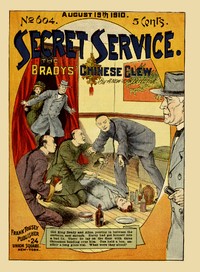
Rereading Dutch the Diver, I kept returning to those tense, quiet moments underwater—how a man’s whole character surfaces in a desperate rescue. It made me think of an old evening in Pell Street, the same hush before a door opens on something dark and personal. There’s a particular patience in The Bradys' Chinese Clew; Or, The Secret Dens of Pell Street — Inside the Classic, that same slow, cautious hand feeling along a wall in the dark.
There are no reviews for this eBook.
There are no comments for this eBook.
Reader reflection
What did you think of this book?
Answer a few questions and save a private reflection on this device.
Your progress
0
/
10
2
Was reading this book enjoyable?
3
Is this a title you would suggest to others?
4
How demanding did the text feel?
5
What was its emotional impact?
6
Would a second reading be valuable?
7
Did you relate to its people, ideas, or situations?
8
Did you gain anything practical from the text?
9
What changed or sharpened your thinking?
10