1

The Bradys After a Chinese Princess; Or, The Yellow Fiends of 'Frisco — Key Ideas to Explore
(0 User reviews)
1901
Project Gutenberg
2011
Not confirmed
Detective and mystery stories; San Francisco (Calif.) -- Fiction; Dime novels
Readers of public-domain and historical texts
Project Gutenberg digital edition
en
Edition facts
Words
37,769
Reading time
165 min
Text sections
5
The catalog record for The Bradys After a Chinese Princess; Or, The Yellow Fiends of 'Frisco — Key Ideas to Explore provides practical reading context through 37,769 words, 2 hr 45 min estimated reading time, and 5 detected text sections.
The text analysis averages about 12.3 words per sentence, while the detected sections provide another way to judge how the source is divided.
Project Gutenberg metadata also associates the work with “Detective and mystery stories,” connecting these edition facts with the source record’s subject description.
Source:
Project Gutenberg record #37314
In this 1911 dime novel, Old and Young King Brady pursue a kidnapped Chinese princess through San Francisco's underworld, encountering hidden treasure, secret passages, and a villainous plot involving opium smuggling.
Read the complete public-domain text at its original source.
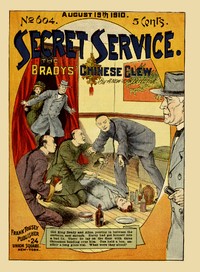
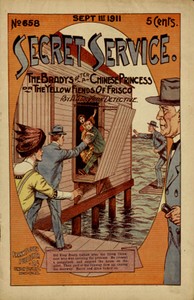
Read on Project GutenbergThe Bradys After a Chinese Princess opens with a motor boat creeping through fog off San Francisco's waterfront at two in the morning. The elderly detective Old King Brady, identifiable by his blue coat with brass buttons and broad-brimmed white hat, leads a team including his younger partner Harry. The catalog subjects list this as detective fiction and a dime novel, and the excerpts confirm both: the story moves through a series of violent encounters, locked rooms, and narrow escapes, with chapter titles like “Alice Passes Through the Door of Death” and “In a Torture Chamber.” The narrative voice is brisk and formulaic, relying on cliffhangers and rapid reversals rather than sustained investigation.
Fog, Boats, and the San Francisco Setting
The opening chapter establishes a specific atmosphere: a “foggy night” on the bay, with a motor boat cruising “close in to the water-front line of lower San Francisco.” This is not a generic city backdrop. The fog and the waterfront recur as functional elements—characters cross gangplanks, enter houses on piles, and navigate hidden rooms. The setting is used for concealment and sudden action, as when a runway flies up to close a doorway. Later, a character named Garshaski mentions bringing a princess over on the Dover Castle, the same boat used to smuggle opium. The excerpts show that San Francisco's Chinatown and its docks are not just scenery but integral to the plot's mechanics of smuggling and kidnapping.
The Princess and the Treasure Secret
The title promises a Chinese princess, and the excerpts deliver her as a plot device rather than a character. She is named Skeep Hup, and her value lies in a secret: “the secret of Gong Schow's hidden treasure.” The villain Garshaski reveals that he kidnapped her to learn this secret, and that Ah Lung, a Chinese merchant, wanted to marry her for the same reason. The princess herself never speaks in the excerpts; she is carried, drugged, boxed up, and pursued. This aligns with the dime novel convention of using exotic figures as prizes or MacGuffins. The catalog subject “detective and mystery stories” fits, but the mystery here is less about crime-solving than about who controls the princess and her treasure.
Violence and the Brady Method
The Bradys do not detect in a conventional sense. Old King Brady “blunders ahead as best he can,” and Young King Brady relies on flashlights, shouting, and breaking down doors. In one scene, Harry stands in darkness after shots are fired, unable to find the shooter, and later admits he was “so rattled that he did not turn on his flash light.” The violence is sudden and bloody: Ah Lung is shot in the head and falls “with a deep groan,” his face covered in blood. The Bradys respond with physical force—Old King Brady breaks down a door “after several attempts.” The catalog genre of “Adventure & Picaresque Fiction” is accurate; the Bradys are more like action heroes than puzzle-solvers, and the story's momentum comes from chases and fights rather than deduction.
Readers should note that the excerpts cover only the first half of the story, ending with Harry trapped in a dark room and Ah Lung wounded. The resolution—whether the princess is rescued, the treasure found, or Alice saved—is not shown here. The narrative's reliance on coincidences and last-minute arrivals (Old King Brady appears “just in the nick of time”) suggests a formulaic structure common to the Secret Service series. Approach this as a period artifact of pulp adventure, where speed and sensation outweigh plausibility.
I found myself thinking of that old Brady tale—the hidden passages and the princess’s peril—and how it all felt like a fever dream. Yet my mind drifted to A Tatter of Scarlet: Adventurous Episodes of the Commune in the Midi 1871 — Edition Insights, a quieter kind of upheaval, where the streets themselves hold secrets, but the danger is memory and lingering hope.
There are no reviews for this eBook.
There are no comments for this eBook.
Reader reflection
Take a moment to reflect on this book
Create a short personal record of your experience with this book.
Your progress
0
/
10
2
Was reading this book enjoyable?
3
Would you encourage someone else to read it?
4
How much effort did this book require?
5
Would you read this book again?
6
How understandable was the text?
7
Would this book work well in a reading group?
8
Did anything about the book feel genuinely new?
9
In one sentence, what did you learn?
10