1

Maid of the Mist — A Reader’s Guide
(0 User reviews)
885
Project Gutenberg
2011
Not confirmed
Shipwreck survival -- Fiction; Physicians -- Fiction; Man-woman relationships -- Fiction; Robinsonades
Readers of public-domain and historical texts
Project Gutenberg digital edition
en
Edition facts
Words
100,741
Reading time
439 min
Text sections
13
Before opening Maid of the Mist — A Reader’s Guide, the edition data offers a quick orientation: 100,741 words, 7 hr 19 min estimated reading time, and 13 detected text sections.
The text analysis averages about 16.4 words per sentence, while the detected sections provide another way to judge how the source is divided.
Project Gutenberg metadata also associates the work with “Shipwreck survival -- Fiction,” connecting these edition facts with the source record’s subject description.
Source:
Project Gutenberg record #37954
John Oxenham's 1917 adventure novel shifts from a fox-hunt opening to a shipwreck survival story, with a doctor protagonist and a woman known only as 'The Girl.' The narrative voice alternates between brisk action and domestic island scenes, with pace changes marked by the hunt's urgency and the careful building of a new home.
Read the complete public-domain text at its original source.
Read on Project GutenbergThe novel opens with a fox hunt, a scene that immediately establishes a brisk, communal pace and a landscape of risk. Riders rein in at the Old Roman Road, a trench-like hazard with a reputation for broken horses and near-disasters. The prose moves with the chase—short clauses, collective anxiety, and the specific detail of a wily fox that always escapes via this route. The fall of Pasley Carew, the Master, is reported with blunt finality: 'the dull crash of his fall came up to them, horribly clear on the still autumn air.' This opening is not merely a set piece; it introduces Wulfrey Dale, the Doctor, as a decisive figure who clears the hedge and immediately runs back to help. The hunt's tempo—fast, then abruptly halted by injury—foreshadows the novel's later shifts between urgent action and quieter, more deliberate scenes.
From Hunt to Hearth: A Shift in Pace and Setting
The transition from the English countryside to a shipwrecked island is abrupt. After the hunt's communal tension, the narrative narrows to two survivors: Wulfrey and a woman referred to only as 'The Girl.' The pace slows markedly. Where the hunt used collective verbs and anxious spectators, the island scenes focus on practical tasks—gathering wood, sand for a hearth, and lighting a fire. The prose becomes deliberate: 'We will take a load of wood across at once and then go for sand.' The Girl's excitement is childlike, and the ritual of starting the fire—'she knelt and applied it, and coaxed and blew'—is described with ceremonial weight. This change in tempo is not merely a break; it reorients the reader from external danger to domestic survival. The voice shifts from reportorial to intimate, with dialogue that reveals character through action rather than exposition.
Voice and the Unnamed Woman
The Girl is never given a proper name in the excerpts, a narrative choice that shapes her role. She is defined by her reactions: 'abrim with excitement,' 'as eager as a child,' and her preference for the second schooner because 'the man of gloom is not here.' The Doctor's perspective dominates, but her voice emerges in practical questions and a blessing over the fire: 'Light and warmth and comfort and peace! God bless the fire!' The narrator endorses this with a hearty 'Amen,' blending her speech with his internal approval. The mate, a third presence, is reduced to glowering silence—'They made no enquiries as to his doings and he volunteered no information.' This asymmetry in voice—the Doctor and The Girl in dialogue, the mate excluded—creates a social microcosm on the island, where language itself becomes a tool of alliance and exclusion.
Recurring Details: Clothing, Tools, and the Wreck-Pile
Oxenham grounds the survival scenes in tangible objects. Clothing is minimal and functional: the Doctor wears 'a long strip of linen wound many times round his waist and falling to the knees like a South Sea islander's.' The Girl's attire is not described, but the pair are called 'as nondescript a pair as could well be imagined in disrespect of clothing.' Tools and materials are itemized—sand for a hearth, flint and steel, a raft, a bucket, half a dozen rabbits. The wreck-pile is a recurring location, a storehouse of salvage that requires swimming or rafting to reach. The mate's earlier claim that they 'have got to swim' is contradicted by the Doctor's careful raft-building. These details are not decorative; they anchor the narrative in physical problem-solving. The pace of the prose mirrors the work: slow during preparation, quick during transport, and punctuated by moments of ceremony like the fire-lighting.
Readers should attend to how Oxenham uses pace as a structural device. The hunt's speed gives way to island routines, but tension remains in the mate's sullen presence and the unspoken threat of the wreck-pile's skeletons. The narrative voice is economical, rarely lingering on emotion but letting action and dialogue carry meaning. The Girl's namelessness is worth noting—it may reflect period conventions or a deliberate focus on her role rather than her identity. The novel's five-book structure suggests further shifts in setting and pace, but the excerpts offer a self-contained arc from communal danger to isolated cooperation.
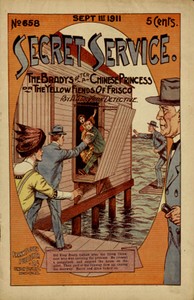
The rain on the windows matched the slow pace of that island-building in Maid of the Mist, all those careful domestic details after the wreck. I found myself thinking about how stories often pivot on a single, strange encounter—and that drifted me toward the raw, breathless urgency of The Bradys After a Chinese Princess; Or, The Yellow Fiends of 'Frisco — Key Ideas to Explore, where every moment feels like that first desperate scramble for shore.
There are no reviews for this eBook.
There are no comments for this eBook.
Reader reflection
How did this book work for you?
Your answers remain private and are stored only in this browser.
Your progress
0
/
10
2
How much did you enjoy the reading experience?
3
Would you pass this book on to a friend?
4
How easy was the book to follow?
5
How did the pace of the book feel?
6
Did any part of the book stay with you emotionally?
7
How clear did the writing feel?
8
How personally connected did you feel to the book?
9
What is the main idea you are taking away?
10