1

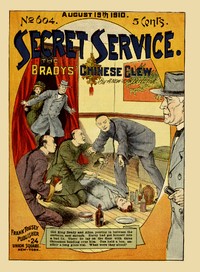
The Bradys' Chinese Clew; Or, The Secret Dens of Pell Street — Inside the Classic
(0 User reviews)
3432
Project Gutenberg
2011
Not confirmed
New York (N.Y.) -- Fiction; Detective and mystery stories; Dime novels
Readers of public-domain and historical texts
Project Gutenberg digital edition
en
Edition facts
Words
33,459
Reading time
146 min
Text sections
4
The Bradys' Chinese Clew; Or, The Secret Dens of Pell Street — Inside the Classic can be approached with a clearer sense of reading commitment from its source measurements: 33,459 words, 2 hr 26 min estimated reading time, and 4 detected text sections.
The text analysis averages about 11.6 words per sentence, while the detected sections provide another way to judge how the source is divided.
Project Gutenberg metadata also associates the work with “New York (N.Y.) -- Fiction,” connecting these edition facts with the source record’s subject description.
Source:
Project Gutenberg record #37092
This editorial note examines how the opening storm, the Chinatown setting, and the early capture of Young King Brady shape a first reading of this 1910 dime novel, focusing on the interplay of atmosphere, dialogue, and serialized cliffhangers.
Read the complete public-domain text at its original source.
Read on Project GutenbergThe Bradys' Chinese Clew opens with a thunderstorm so violent that it “taxed the memory even of the oldest inhabitant” to recall its equal. This weather event is not mere backdrop; it sets the stage for the Bradys’ late-night meeting in a Pell Street chop suey restaurant, where the detectives wait for a Mr. Butler who never arrives. The storm’s intensity mirrors the tension of the case they are about to pursue, and the early pages establish a pattern of interrupted conversations and looming threats. The narrative voice is brisk, favoring action over introspection, and the dialogue between Old and Young King Brady reveals their professional rapport and a personal stake—Alice’s welfare—that hints at deeper motives.
The Storm as a Structural Device
Later, when Young King Brady is captured and led through underground passages, the storm is absent, but its memory lingers. The shift from the chaotic outdoors to the stifling interior of the secret dens underscores the transition from public to concealed spaces. The storm’s absence in the later excerpts makes the reader aware of how much the setting has changed—from the open threat of weather to the closed, claustrophobic threat of the tongs.
Dialogue as a Window into Character and Plot
Notably, the dialogue often carries the burden of exposition. When Joe Ding explains the tong’s existence and Harry’s death sentence, the reader learns the stakes without lengthy description. The conversation also reveals Harry’s skepticism—he demands proof and questions Joe’s sincerity. This back-and-forth creates a tension that propels the narrative forward, even as the physical action is temporarily suspended.
The Secret Dens and the Geography of Chinatown
The physical layout mirrors the plot’s complexity. Just as Harry is led through a maze, the reader is guided through a series of revelations and reversals. The dens are also a site of negotiation: Joe Ding’s offer to free Harry takes place in this underground room, turning the space from a trap into a potential escape route. The geography thus becomes a character in itself, shaping the action and the characters’ choices.
Serialized Cliffhangers and the Reader’s Role
The reader is positioned as an active participant, piecing together clues alongside the detectives. The text’s reliance on dialogue and action rather than interior monologue means that the reader must infer motives from behavior. This participatory quality is heightened by the serial format, where each installment ends with a hook that demands the next issue. The excerpts provided show how the story builds momentum through a series of escalating threats, from the storm to the capture to the tong’s death decree.
For a first reading, pay attention to how the storm’s energy dissipates as the action moves indoors, and how the dialogue shifts from casual to conspiratorial. The Bradys’ methods are revealed through their interactions, not through explicit description. The serialized structure means that each chapter ends with a question, and the reader must decide which threads to follow. The dens of Pell Street are both a physical and narrative maze; navigating them requires patience and attention to the clues embedded in the characters’ words.
That storm opening in the old Brady story, all that oppressive gloom before anything happens, stayed with me long after. It made me think of another ragged, uncertain time—the Commune’s aftermath in the Midi, where the air itself feels heavy with unspoken things. The quiet suspense is the same, a lingering weight rather than a plot hook. There’s a specific book, A Tatter of Scarlet: Adventurous Episodes of the Commune in the Midi 1871 — Edition Insights, that holds that exact feeling for me.
There are no reviews for this eBook.
There are no comments for this eBook.
Reader reflection
Take a moment to reflect on this book
Create a short personal record of your experience with this book.
Your progress
0
/
10
2
Was reading this book enjoyable?
3
Would you pass this book on to a friend?
4
How much effort did this book require?
5
Would this book work well in a reading group?
6
What did you think about the pace?
7
Which part made the strongest impression?
8
How distinctive were its ideas or approach?
9
In one sentence, what did you learn?
10